Exposition Nationale et Coloniale Rouen 1896

The Exposition Nationale et Coloniale de Rouen of 1896 was the sixth in a line of Rouen exhibitions reaching back to the industrial displays of the early nineteenth century, and the direct successor to the fairs of 1859 and 1884. Its principle was adopted on 1 May 1894, and preparation fell to a general committee of 185 members — industrialists, learned-society presidents, bankers, newspaper directors — under Xavier Knieder, director of the Malétra chemical works and a former president of the Société industrielle de Rouen. Alongside him stood the notables of the local economy: the grain distiller Gaston Boulet, the printed-cotton manufacturer Maurice Keittinger, Louis Besselièvre, Georges Le Verdier, Delamare-Debouteville, and the museum director Gaston Le Breton. The budget was set at two million francs, half for construction, to be recovered through subventions, subscriptions, gate receipts, and exhibitor rents; the exhibitors would number 6,431, most admitted without charge.
The site was the Champ-de-Mars, beneath the Côte Sainte-Catherine, the army having released the ground in 1895. The architect Ruel laid out some 57,000 m² of buildings and gardens — a central gallery perpendicular to the Machinery Hall, a Beaux-Arts gallery leading to a “Salon parisien,” a thousand-seat Salle des Fêtes, and annexes for education, the workers’ exhibition, the Villages Noirs, and the reconstructed Vieux Rouen — in a deliberately festive idiom of wood and staff, materials meant for demolition at the close. The exhibitors were distributed across thirteen groups, from Enseignement and the Arts libéraux through the mechanical, extractive, and colonial industries. The whole was brilliantly lit, electrically for the interiors and by gas in the gardens. President Félix Faure visited on 14 and 15 August; the fair drew 624,291 paying admissions over its five months, an average near four thousand a day, the reduced-rate tickets for groups and schools leaving a deficit to be absorbed.
For the organizers, the “clou” of the exhibition lay in two picturesque attractions: Jules Adeline’s full-scale reconstruction of Vieux Rouen, an exercise in the era’s growing patrimonial sensibility, and the Villages Noirs, the African ethnographic display that lent the fair its colonial dimension and which, in Jean-Pierre Chaline’s modern reading, did most to fix it in local memory. The fair opened on 16 May 1896 and closed on 17 October, the final day given over to the distribution of prizes and medals; the structures were then demolished, leaving only scattered fragments. Among the garden installations — keyed on the official site plan as legend E, in the northern cluster of charitable and educational exhibits beside the Villages Noirs — was a “Couveuse d’enfants,” an infant-incubator exhibit.
The Incubator Exhibit
The couveuse pavilion was operated by M. A. de Miomandre and his wife, Mme Jeanne de Miomandre, who ran the Paris-based Œuvre de la propagation des couveuses d’enfants (seat at avenue de la République, with a branch at Toulouse). The enterprise was independent of Alexandre Lion’s Œuvre maternelle des couveuses d’enfants, and it was a family affair: the Journal de Rouen records that A. de Miomandre and Gaston Gilles were both sons-in-law of M. Dessolins, a former contributor to that paper, and that Mme Gilles was Rouennaise by birth. The Gilles couple had run the œuvre’s pavilion at Charleroi in 1895. The Dessolins connection explains both the Rouen branch and the warm, frequent coverage the enterprise received in the Journal de Rouen.
The œuvre announced its intention to exhibit at Rouen in November 1895, citing its Charleroi pavilion of that year as precedent (Journal de Rouen, Nov. 22, 1895); the exposition’s conseil supérieur reserved a couveuse site in the Champ-de-Mars gardens in early December (Dec. 5,1895). The œuvre first opened a Rouen branch at 20 rue d’Amiens, “prête à fonctionner, sous la direction même des fondateurs [ready to operate, under the direct guidance of the founders themselves], M. et Mme de Miomandre” (Jan. 4, 1896), and then, when the exposition opened, transferred that establishment into the garden pavilion: “M. et Mme de Miomandre… ont transporté à l’Exposition leur ancien établissement de la rue d’Amiens” [transported their former establishment from Rue d’Amiens to the Exhibition] (May 22, 1896). The pavilion stood beside the Villages Noirs, near a cinematograph, with the Union des Femmes de France and the Société de Secours aux Blessés Militaires close by.
The pavilion exhibited living premature infants at an admission of 50 centimes (Journal de Rouen, May 22, 1896; corroborated by Émile Duhem’s “paid attraction,” Oct. 3). The May 22 notice reports two prématurés resident since the opening, with weights: one born at seven months, admitted at 1,190 g and then 1,400 g; another born at eight months, 1,790 g and then 1,832 g after twelve days. Georges Dubosc’s signed, illustrated feature of October 11 gives the fuller tally — eleven infants passed through the couveuses since the opening, two died (one with pneumonia), three present, including “le petit Robert,” born at seven months. The large survival statistics Dubosc reproduces (the Maternité de Paris figures, and 284 infants with 84 % survival at the Hospice-Général de Rouen) belong to those hospitals, not to the pavilion.
Two apparatus types were shown, which Dubosc distinguishes. The first was the Miomandres’ own design: a suspended cradle in the form of an ordinary berceau, with white and pink curtains falling on either side and a crystal lid, its heating “dissimulé dans la partie inférieure de sa corbeille” — attributed by name to M. A. de Miomandre (Jan. 4 and Oct. 11, 1896). The second was a square glass vitrine on a castored metal frame, the infant on a glass plate above a water reservoir (bouillotte) heated by a gas-fired thermosiphon, with an automatic Roux regulator, internal thermometer, humidity sponge, and electric temperature alarm — a cabinet of the modified Tarnier/Auvard lineage. The Miomandre œuvre’s method, as described across the January 4 and October 11 pieces, included heated padded cradles for collecting infants from home, frequent weighing, the téterelle bi-aspiratrice for expressing milk, gavage by fine tube for infants too weak to suck, and doctors’ orders chalked on a slate beside each couveuse. In Dubosc’s survey of apparatus, “la couveuse Lion” appears only as a comparison model, named for its chimney-and-propeller draught indicator — not as an operator at Rouen.
A fire of 19 August 1896, was widely reported in the press in connection with the Miomandre pavilion. The fullest account, local and detailed (Journal de Rouen, 20 August), records that about four o’clock a gas rampe lit beneath hanging flags at the Villages Noirs entrance — despite an explicit warning to the gaziers — ignited a flag and then the thatched entrance turrets; the flames threatened the Société de Secours tent on one side and the couveuses on the other. “Mme de Miomandre, directrice des Couveuses,” had the pavilion cleared; a bystander, M. Blouet, carried the infants out one by one, wrapped in blankets, to the Union des Femmes de France tent. The national dispatches (Le Mot d’Ordre, 22 Aug; La Libre Parole and Le Petit Moniteur Universel, 21 Aug) are compressed relays of this incident; the Mot d’Ordre’s detail that the infants were carried out at once is confirmed, in full, by the local account.
The Alexandre Lion Puzzle
The official publications tell a, at first sight, contradictory story. Alexandre Lion is registered in the exhibitor catalogue (Classe 9, no. 296) with “Couveuses d’enfants, système Lion,” a temperature regulator, and laboratory étuves, and appears in the awards supplement, the Liste des Récompenses, as hors concours in Classe 9, admitted at his own request under article 2 of the jury’s special rules. The Miomandres appear in none of the official publications — not the exhibitor catalogue, the official bulletin, the Revue illustrée, or the Liste des Récompenses. The two records are almost perfectly complementary. Lion appears in the official registers but in no press notice on the ground; the Miomandres appear in every press notice on the ground but in no official register.


Left: Exposition Nationale & Coloniale Rouen 1896 Catalogue Officiel de l’Exposition, p. 107
RIght: Catalogue officiel de l’Exposition nationale et coloniale, Rouen 1896: Liste des Récompenses. 2ᵉ éd., p. 42.
The consistent absence of the Miomandres from four official or semi-official publications, set against their continuous documented operation of the pavilion in the local press, indicates that their installation was a concession or attraction outside the formal exhibitor structure — which is why it left no trace in the official record. Lion’s entry, by contrast, reflects registration only; the catalogue went to press before the opening, and his request for hors-concours status means no jury report records what, if anything, he actually showed. No press coverage that describes a separate Lion installation on the grounds has been found. The relationship between Lion’s registration and the Miomandre pavilion is unresolved based on the available evidence. In any case, the operator of record was the Miomandre œuvre.
Afterward and Record
The pavilion was still a recalled reference point in the regional press two years later: L’Écho de la Vallée de Bray (September 17, 1898) names “Mme Jeanne de Miomandre,” recalls her direction of the Rouen couveuse pavilion in 1896, and reprints an infant-diarrhoea remedy, attributed to Auvard, that she had sent to the Rouen papers.
Beyond the nationally circulated fire dispatch, the exhibition drew limited attention in the national press during its run, while the local Journal de Rouen followed the fair, and the couveuse pavilion, closely. The pattern fits a regional event of regional importance, and a family concession covered warmly by a paper tied to its proprietors. Similarly, no photograph of the Rouen couveuse pavilion, and no souvenir postcard of it, has been located in postcard or image repositories in the United States or Europe, despite deliberate searches by the present writer. The retrospective record also passes the pavilion over. Jean-Pierre Chaline’s standard modern study (2003) does not mention the couveuses at all, fixing, like the Revue illustrée’s own retrospective, on Vieux Rouen and the Villages Noirs.
The site plan in the Revue illustrée de l’exposition de Rouen (Lecerf, 1897), with its keyed legend (p. 17), fixes the incubator exhibit’s location, adjacent to the educational galleries, the Poste de Secours aux Blessés, the Union des Femmes de France, and the Société de Secours aux Blessés Militaires.
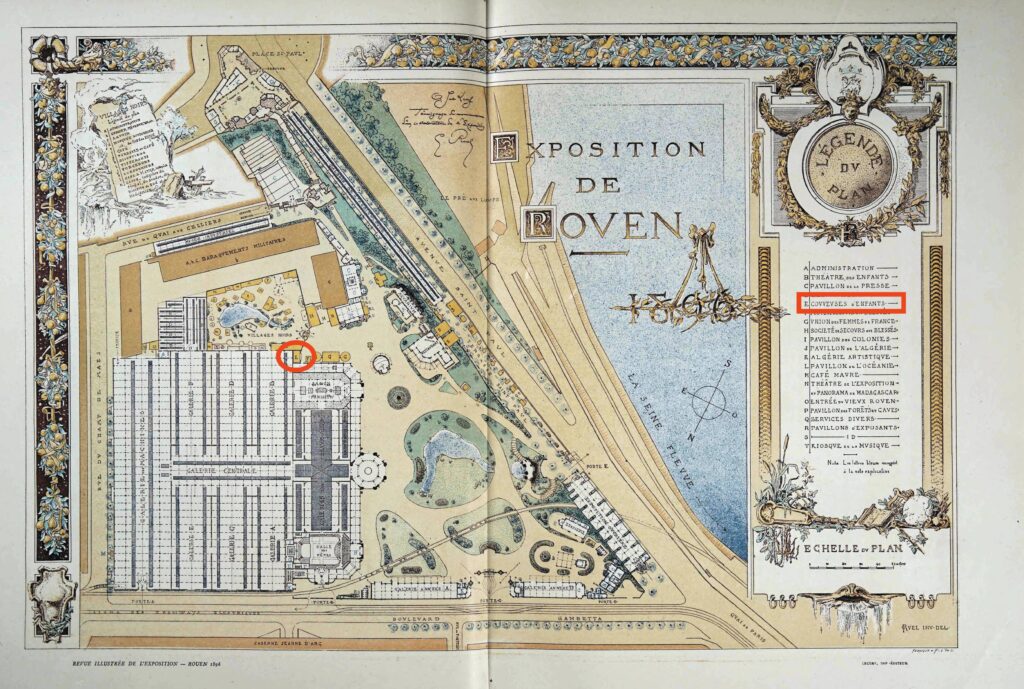
is marked with a red circle. Source: Rouen 1896 Revue Illustré de l’Exposition.
Primary Sources
- Catalogue officiel de l’Exposition nationale et coloniale, Rouen 1896. Paris: Imp. Lemercier, [1896], p. 107, no. 296 (Alexandre Lion, “Couveuses d’enfants, système Lion”). — Operator and system. Internet Archive: https://archive.org/details/expositionnation00expo_1
- Catalogue officiel de l’Exposition nationale et coloniale, Rouen 1896: Liste des Récompenses. 2ᵉ éd. Rouen: Ancienne Imprimerie Ch.-F. Lapierre, 1896, p. 42, Classe 9 (Médecine, Chirurgie, Hygiène), Hors Concours (“Lion, Alexandre, Paris”). — Official award status: hors concours, not Grand Prix as stated in Lion’s Paris souvenir booklet. Internet Archive: https://archive.org/details/expositionnation00expo_2/page/n7/mode/2up
- Revue illustrée de l’exposition de Rouen. Rouen: Lecerf, 1897. Site plan (Avel del.; Fernique & Fils ph.) and keyed legend, p. 17, “Couveuse d’enfants (E).” — Presence and location. Internet Archive: https://archive.org/details/revueillustreede00unse
- Bulletin officiel de l’Exposition nationale et coloniale de 1896. Gallica: http://catalogue.bnf.fr/ark:/12148/cb32862895g
- Exposition nationale et coloniale de Rouen 1896 – Rapport Général de M. Eug. Garnier, Secretaire General. Gallica: http://catalogue.bnf.fr/ark:/12148/cb30482235d
- Journal de l’Exposition nationale & coloniale de Rouen et moniteur des exposants : hebdomadaire illustré. No. 1. Gallica: http://catalogue.bnf.fr/ark:/12148/cb32797734n
- Vieux Rouen reconstitué à l’exposition nationale et coloniale, Rouen 1896, by Jules Adeline, 1896. Gallica: http://catalogue.bnf.fr/ark:/12148/cb365744775
- Raoul Aubé, garden-promenade essay, Revue illustrée de l’exposition de Rouen, p. 65. — Sole descriptive notice of the exhibit. Internet Archive: https://archive.org/details/revueillustreede00unse
Journal de Rouen (operation, attribution, apparatus, fire)
- “Chronique locale: Les Couveuses d’Enfants,” 22 November 1895 — introduces the Miomandre œuvre; Dessolins family structure (Miomandre and Gilles as sons-in-law); Rouen pavilion announced; Charleroi 1895 precedent; Bordeaux “clou” (Lion) cited; 19 April 1895 testimonial reproduced.
- “L’Exposition de Rouen 1896” [conseil supérieur], 5 December 1895 — couveuse site reserved in the Champ-de-Mars gardens; Declais garden architect; Lion/Miomandre venues conflated generically.
- “Le Sauvetage de l’Enfance,” 4 January 1896 — branch at 20 rue d’Amiens under the Miomandres; berceau-couveuse attributed to M. A. de Miomandre; method and equipment; hospital statistics distinguished.
- “Chronique locale: L’Exposition de Rouen: Les travaux,” 26 April 1896 — pavilion under construction beside the Villages Noirs; Simon cinematograph adjacent.
- “Chronique locale: À l’Exposition,” 22 May 1896 — transfer of the rue d’Amiens establishment to the pavilion; two living prématurés with weights; 50 c admission.
- “À l’Exposition,” 20 August 1896 — fire of 19 August; Mme de Miomandre has the infants evacuated.
- Georges Dubosc, “Par ci, Par là: Les couveuses d’enfants,” 11 October 1896 (illustrated) — signed feature; both apparatus types; results (11 infants, 2 deaths, 3 present); “la couveuse Lion” named only as a comparison model.
Other Contemporary Press
- La Patrie, 17 May 1896 — couveuse among opening-day garden attractions.
- Journal de la ville de Saint-Quentin et de l’arrondissement, 3 October 1896 (Émile Duhem) — incubators a “paid attraction.”
- Le Mot d’Ordre, 22 August 1896 — fire of 19 August; reports the infants carried out.
- La Libre Parole and Le Petit Moniteur Universel, both 21 August 1896 — fire of 19 August; shared dispatch, one stream.
- L’Estafette, 6 September 1896 (Léon Bigot) — tour impression; contextual.
- L’Écho de la Vallée de Bray, 17 September 1898 — retrospective; “Mme Jeanne de Miomandre”; Auvard remedy reprinted.
Secondary Sources
- Jean-Pierre Chaline, “Les expositions industrielles et coloniales à Rouen au XIXᵉ siècle,” Études Normandes, 52ᵉ année, no. 4 (2003), “Gloires du XIXᵉ siècle,” pp. 31–44. DOI 10.3406/etnor.2003.1520. — Dates, scale, attendance (624,291), architect (Ruel), organization; closing date 17 October.
- Exposition Nationale et Coloniale Rouen 1896 – WIkipedia [French]
General Information about Alexandre Lion
- General Information
- Alexandre Lion
- The Lion Incubator
- The Engineer and the Newborns, by W. A. Nelson and Paul L. Toubas
- Lion Patents (France)
- Patent 201550, 1889, Couveuse électro-automatique
- Patent 221716, 1892, Couveuse automatique
- Patent 262090, 1896, Chambre vivifiante
- Patent 281687, 1898, Système de filtration de l’air
- Patent 287557, 1899, Système de filtration des fumées, de l’air et de toutes masses gazeuses avec tirage et ventilation
- Patent 189989, 1899, Appareil pour le filtrage et la purification de l’air et des fumées
- Maternité Lion Institutes and City Exhibits
- Alexandre Lion’s first incubator baby exhibit in Marseille, 1890.
- Œuvre Maternelle des Couveuses d’Enfants, Nice
- Œuvre Maternelle des Couveuses d’Enfants, Lyon
- Œuvre Maternelle des Couveuses d’Enfants, Paris
- Œuvre Maternelle des Couveuses d’Enfants, Toulouse
- Œuvre Maternelle des Couveuses d’Enfants, Amiens
- Œuvre Maternelle des Couveuses d’Enfants, New York
- Œuvre Maternelle des Couveuses d’Enfants, Barcelona
- Œevre Maternelle des Couveuses d’Enfants, Brussels
- Maternité Lion Souvenir Booklets
- Œuvre Maternelle des Couveuses d’Enfants , Paris Institute, Booklet Version #1 (appears to be ~1896)
- Œuvre Maternelle des Couveuses d’Enfants , Paris Institute, Booklet Version #2 (appears to be ~1901)
- Pamphlet from Alexander Lion’s exhibit at the 1898 exhibition in Torino, Italy. (PDF supplied by Dr. Thijs Gras, Amsterdam)
- Press Coverage
- La Maternité “Lion de Nice” pour Enfants Nés Avant Terme ou Débiles, by Dr. Ciaudo, 1895. Source: gallica.bnf.fr.

- Presentation d’Appareil, by M. A. Pinard, Bulletin de l’Académie nationale de médecine, 1893. Source: gallica.bnf.fr.
- Les couveuses d’enfant et le gavage, by César-A Queirolo, Includes discussion of Lion incubator and comparison to other types. Thèse de doctorat: Univ. Genève, 1897.
- Les Couveuses pour Enfants, Gazette Médicale de Paris, No. 40, October 6, 1900
- Couveuses d’Enfants, La Maternité Lion, Paris, La Patrie, 1897
- Paris Letter: An Improved System of Incubators, by O. Jennings, Pediatrics 1:427-428, 1896
- Baby Incubators, The Strand Magazine, 1896, by James Walter Smith
- Human Infant Incubation: A True Fairy-Tale of Modern Science from Leslie’s Weekly, 1897
- The Saving of Human Life, Maternité Lion in NYC, The Literary Digest, 1898
- Immature Infants in France, from The Lancet, January 16, 1897, page 196.
- De Lion Incubator at Low Maternity Hospital, by Francis H. Stuart, Brooklyn Medical Journal, 1901
- Alexandre Lion’s Incubator Charities in Europe (1894–1898) (The Embryo Project)
- La Maternité “Lion de Nice” pour Enfants Nés Avant Terme ou Débiles, by Dr. Ciaudo, 1895. Source: gallica.bnf.fr.
- Worlds Fairs and Expositions
- Maternité Lion at the Lyon Exposition Universelle et Coloniale, 1894
- Maternité Lion at the Lyon Exposition Universelle – Le Monde Illustré, 1894
- Maternité Lion at the Bordeaux Exposition of 1895.
- “La Maternité Lion,” by Louis Énault, Journal of the Bordeaux Exposition, 1895
- Maternité Lion at the Amsterdam World Exposition, 1895
- Maternité Lion at the Berliner Gewerbeausstellung, 1896
- “Bericht ǔber die Couveuse (Lion) oder Kinderbrutanstalt” [Report about the Lion Incubator] from Berlin und seine Arbeit – Amtlicher Bericht der Berliner Gewerbe-Ausstellung 1896. English Translation.
- Maternité Lion at the Exposition National Suisse, Geneva, Switzerland, 1896
- “Quelques Réflexions sur le Fonctionnement et les Résultats des Couveuses Lion pendant l’Exposition Nationale,” by Dr. Hector Maillart, Revue Médicale de La Suisse Romande, 1896. English translation.
- Internationale Ausstellung für Körperliche Erziehung, Gesundheitspflege und Sport, Innsbruck, 1896
- Maternité Lion at the Tennessee Centennial Exposition, 1897
- Maternité Lion at the Brussels International Exposition, 1897
- Maternité Lion at the Turin L’Esposizione Generale Italiana, 1898
- Maternite Lion at the Ghent Provincial Exposition of 1899
- Maternité Lion at the Greater Britain Exhibition of 1899
- Maternité Lion at the Paris Exposition Universelle of 1900
- Maternité Lion at the Woman’s Exhibition in Earls Court, London, 1900
- Maternité Lion at the Lille Exposition of 1902
- Maternité Lion at the Exposition Internationale de Reims, 1903
- Maternité Lion at the Nantes Exposition of 1904
- Maternité Lion at the Exposition du Nord de la France, 1904
- Maternité Lion at the Liège Exposition Universelle et Internationale, 1905.
- Maternité Lion at the Marseille Colonial Exposition of 1906
- Maternite Lion at the Bordeaux International Maritime Exposition of 1907
- Maternité Lion at the Marseille Exposition Internationale d’Électricité, 1908
- Maternité Lion at the Exposition Internationale de l’Est de la France, Nancy, France, 1909
- Maternité Lion at the Brussels Exposition Universelle et Internationale, 1910
- Maternite Lion at the Exposition du Centre de la France, Clermont-Ferrand, 1910
- Maternité Liion at the Rome International Exposition of 1911
- Maternité Lion at the Turin International Exposition of 1911
- Maternité Lion at the Exposition Internationale de Dunkerque, 1912
- Maternité Lion at the Ghent International Exposition of 1913
- Maternité Lion at the Exposition Internationale Urbaine de Lyon, 1914
- Maternité Lion at the Lyon Exposition Universelle et Coloniale, 1894
French primary sources were machine-translated, then checked against the originals and edited by the author. Portions of this page were drafted with machine assistance; the final text was reviewed, verified, and edited by the author. Click here to learn more.
Last Updated on 10/24/26