Exposition Internationale de Dunkerque, 1912
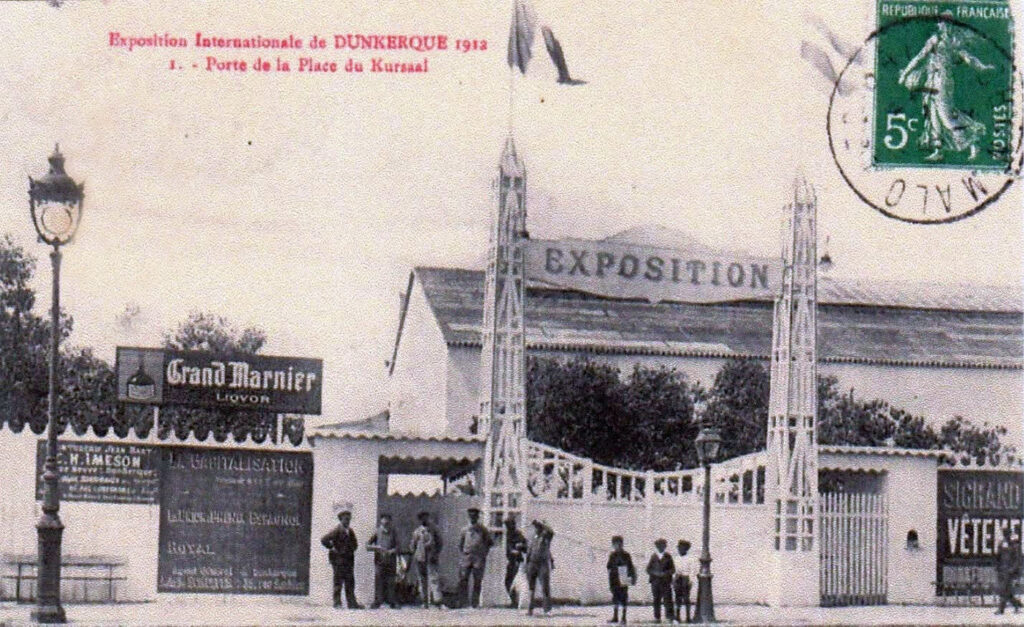
The Exposition Internationale de Dunkerque was a regional industrial, commercial, and artistic fair held in the summer of 1912 under the joint patronage of the municipalities of Dunkirk and Malo-les-Bains, administered by a General Commission seated at 10 rue Carnot under Commissioner-General Paul François. Its promotion was explicitly opportunistic: notices circulated to the provincial press through 1911 and early 1912 advertised it as the only exhibition of its kind in France that year, and the site, laid out between the canals and the dunes and incorporating the existing Kursaal, was chosen for its proximity to the bathing resort of Malo-les-Bains in order to draw on the summer holiday traffic. The opening was delayed and staggered: storms had held up construction, and although the season had been announced for 15 June, the gates opened on 22 June with admission reduced “because the exhibitors are not yet ready.” A formal inauguration by the civil and military authorities followed on 14 July, and a closing was scheduled for 6 October.
The official classification, recorded in the Brussels periodical La Vie Internationale in 1912, distributed the serious content across roughly nine principal pavilions and numerous annexes—covering education and the fine arts, metallurgy, electricity, civil engineering, transport and maritime affairs, fisheries, agriculture and forestry, food products, furniture and textiles, the chemical and pharmaceutical industries, and the social economy. Among the named structures were a Palais des Machines, a Palais de la Femme et du Luxe, palaces of the Liberal and Fine Arts, a sports palace, a hygiene and pharmaceutical products section, and a foreign section including a Brazilian Pavilion inaugurated on 15 July by a government minister. The scale was modest, and the local press cautioned readers against expecting an exhibition on the order of Brussels or Roubaix; daily attendance was reported at roughly three to four thousand, and in mid-July the administration reduced season-pass prices to attract resident families.
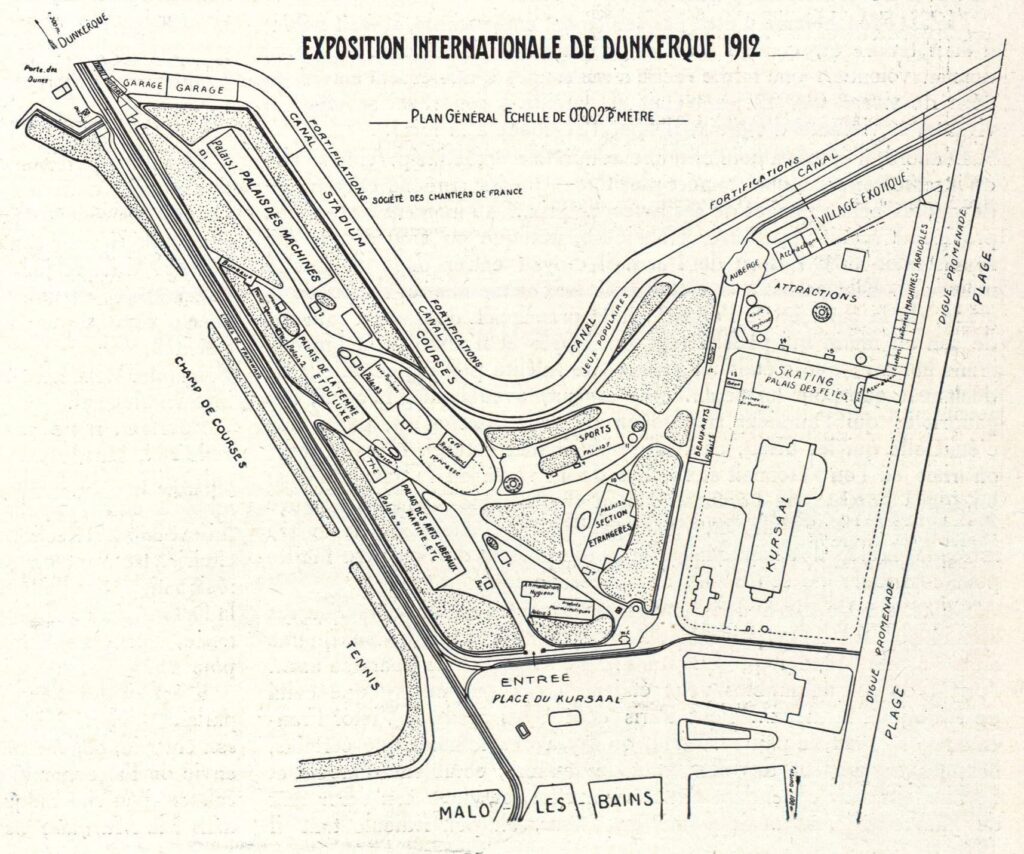
The fair’s popular appeal rested on a dense calendar of festivities and on a separate amusement quarter set across the canal from the palaces, in the north-east of the grounds. Its principal draw was an ethnographic “human zoo” display—initially a “Somali village,” presented with staged parades, mock combats, and dances and described in the dehumanizing terms characteristic of the genre, which departed in early August and was replaced around 11 August by a “Senegalese-Guinean” village. The quarter also held a Dervish theatre, a skating rink, a “Roue Joyeuse,” a “Rolling-Tub,” and infant incubators, while the programmed events included cycling races—among them a Paris–Dunkirk stage of the Tour de France—regattas, a cross-town swim, recurring Flemish fairs, balloon ascents, a baby contest, a dog show, horse races, the touring Rancy circus, evening fêtes with illuminations and fireworks, and an infant incubator exhibit.
The exposition suffered two separate fires. The first, in mid-August, destroyed the “Roue Joyeuse” shortly after midnight following a flower festival, the other structures being protected. The second and larger fire, on the evening of 9 September, originated near the Kursaal, destroyed the Brasserie Universelle—a wooden complex surmounted by a dome reused from an earlier Brussels exhibition—badly damaged the Brazilian Pavilion, and threatened the Liberal and Fine Arts palaces before the fire service contained it; accounts of the damage varied, and the existence of the earlier fire accounts for the description of the September event as “un nouvel incendie” in one Paris dispatch. Once open, the fair attracted little national press attention, as befitted a provincial exhibition of middling importance; the September fire was the conspicuous exception, drawing sustained coverage in French and Belgian newspapers over several weeks—markedly more than the fair received while functioning. It has since been studied by the Dunkirk historian Michel Tomasek in the Revue historique de Dunkerque et du littoral (2013), which addresses its organization, its difficulties, and its colonial spectacle.
The infant incubator pavilion
The amusement quarter included a pavilion exhibiting infant incubators with live infants (“couveuses d’enfants avec bébés vivants”), advertised in the fair’s attractions roster throughout the season. It appears among the named attractions in the opening-day programme of 22 June and recurs in at least six issues of Dunkerque l’Été between then and 18 August, consistently grouped with the Roue Joyeuse, the Rolling-Tub, and the exotic village—locating it in the north-east amusement quarter shown on the general plan, well separated from the Kursaal zone that burned on 9 September. The stand charged its own admission, distinct from the fair’s general entry. The local press,, does not identify who ran it or any of the other attractions in the amusement zone, and—although the paper’s advertising pages (occupied entirely by local merchants, with no fairground concession advertising among them) were examined for the full surviving run of Dunkerque l’Été—no advertisement for the concession was found.
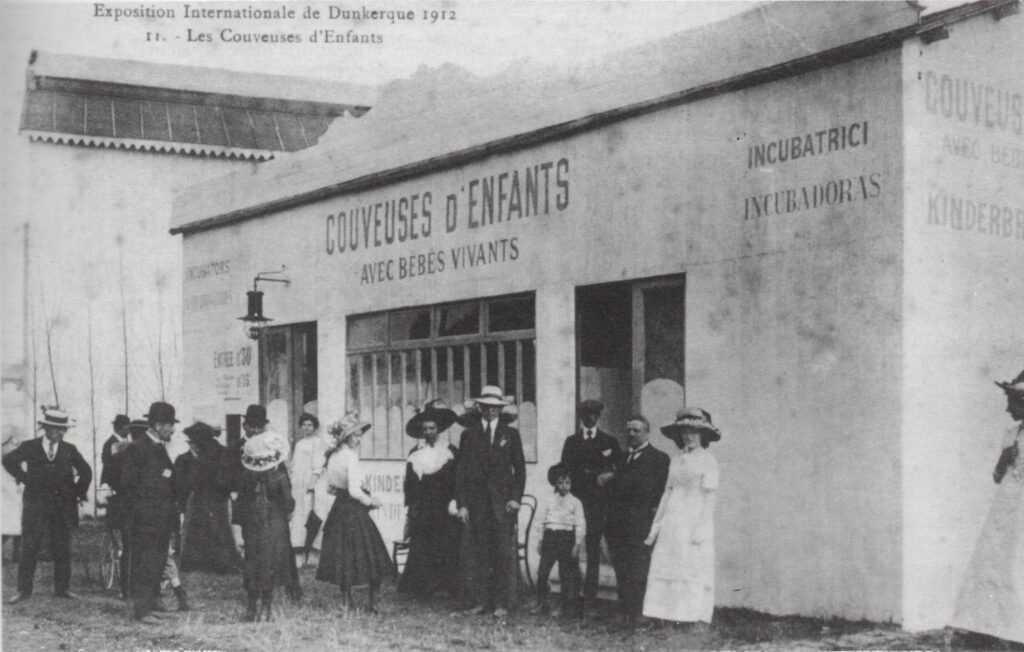
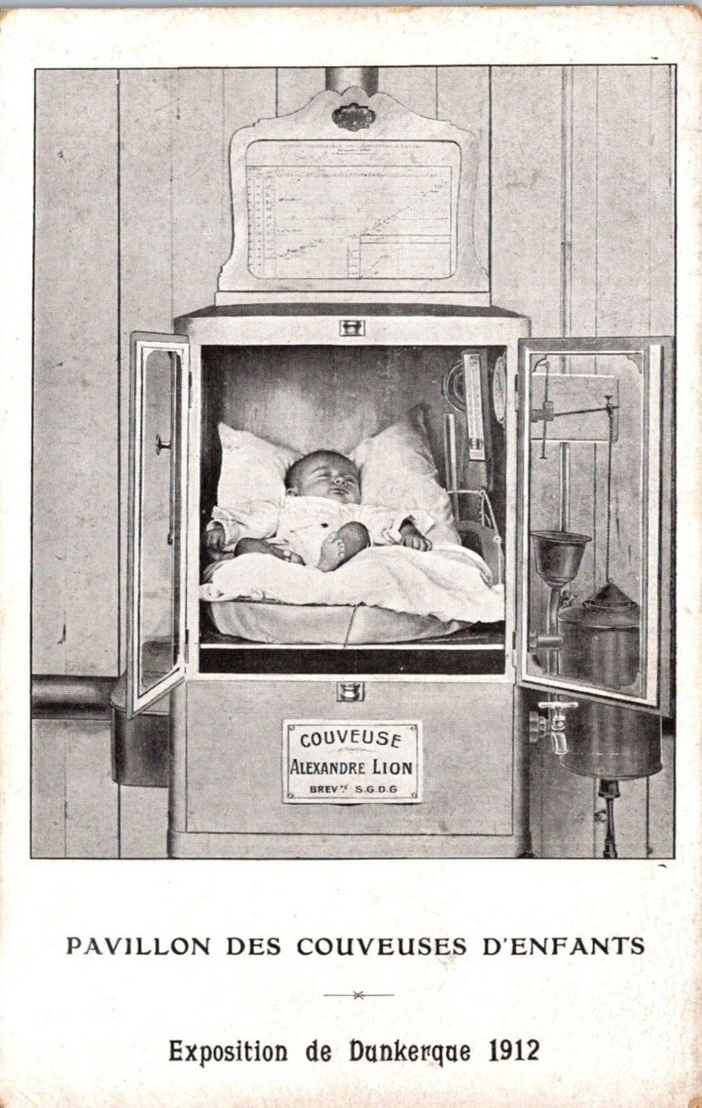
Although it is not documented in any news accounts discovered to date, it is apparent from pictorial sources that the purveyor of the infant incubator exhibit was Alexandre Lion, who exhibited at many of the Worlds Fairs and expositions in the early 1900s and also maintained more permanent storefronts under the brand of “Oeuvre Maternelle des Couveuses d’Enfants” in Paris, Nice, and other cities. Two souvenir postcards have been found that are captioned to the Dunkerque exposition of 1912, one a numbered series view of the pavilion exterior (“Les Couveuses d’Enfants … avec bébés vivants,” with multilingual signage), the other an interior view of a single incubator bearing the maker’s plate “Couveuse Alexandre Lion, Breveté S.G.D.G.” Both are consistent in format with Lion’s documented installations elsewhere.
References
- Verified primary sources (BnF Gallica; parent serial ark:/12148/cb32759227n):
- Dunkerque l’Été, no. 8, 7 July 1912 — ark:/12148/bpt6k4516532t
- Dunkerque l’Été, no. 9, 14 July 1912 — ark:/12148/bpt6k45165337
- Dunkerque l’Été, no. 10, 21 July 1912 — ark:/12148/bpt6k4516534n
- Other issues of Dunkerque l’Été consulted: 19 May, 23 June, 28 July, mid-August (Roue Joyeuse fire), and 18 August 1912, with the run extending to 29 September 1912.
- Official classification: “Dunkirk International Exhibition, 1912,” La Vie Internationale, t. 1, fasc. 4 (Brussels: Office central des associations internationales, 1912).
- Pre-opening recruitment notices: Journal de Beaune, 14 Sept. 1911 and 20 Jan., 15 Feb., 2 Apr., 4 June 1912; Journal de la Ville de Saint-Quentin (suppl.), 21 Jan. 1912; La République Française, 21 Jan. 1912; La Libre Parole, 22 Feb. 1912; Le Radical, 29 Feb. 1912; Le Guetteur de Saint-Quentin et de l’Aisne, 29 Mar. 1912; Le Soleil, 1 June 1912.
- National/regional coverage of the 9 September fire: Le Petit Parisien, 10 Sept. 1912; Excelsior, 10 Sept. 1912; L’Indépendant du Cher, 12 Sept. 1912; La Lanterne, 12 Sept. 1912.
- Secondary source: Michel Tomasek, “L’exposition internationale de 1912 à Dunkerque…,” Revue historique de Dunkerque et du littoral, no. 46 (2013), pp. 133–166.
More Information about Alexandre Lion
- General Information
- Alexandre Lion
- The Lion Incubator
- The Engineer and the Newborns, by W. A. Nelson and Paul L. Toubas
- Lion Patents (France)
- Patent 201550, 1889, Couveuse électro-automatique
- Patent 221716, 1892, Couveuse automatique
- Patent 262090, 1896, Chambre vivifiante
- Patent 281687, 1898, Système de filtration de l’air
- Patent 287557, 1899, Système de filtration des fumées, de l’air et de toutes masses gazeuses avec tirage et ventilation
- Patent 189989, 1899, Appareil pour le filtrage et la purification de l’air et des fumées
- Maternité Lion Institutes and City Exhibits
- Alexandre Lion’s first incubator baby exhibit in Marseille, 1890.
- Œuvre Maternelle des Couveuses d’Enfants, Nice
- Œuvre Maternelle des Couveuses d’Enfants, Lyon
- Œuvre Maternelle des Couveuses d’Enfants, Paris
- Œuvre Maternelle des Couveuses d’Enfants, Toulouse
- Œuvre Maternelle des Couveuses d’Enfants, Amiens
- Œuvre Maternelle des Couveuses d’Enfants, New York
- Œuvre Maternelle des Couveuses d’Enfants, Barcelona
- Œevre Maternelle des Couveuses d’Enfants, Brussels
- Maternité Lion Souvenir Booklets
- Œuvre Maternelle des Couveuses d’Enfants , Paris Institute, Booklet Version #1 (appears to be ~1896)
- Œuvre Maternelle des Couveuses d’Enfants , Paris Institute, Booklet Version #2 (appears to be ~1901)
- Pamphlet from Alexander Lion’s exhibit at the 1898 exhibition in Torino, Italy. (PDF supplied by Dr. Thijs Gras, Amsterdam)
- Press Coverage
- La Maternité “Lion de Nice” pour Enfants Nés Avant Terme ou Débiles, by Dr. Ciaudo, 1895. Source: gallica.bnf.fr.

- Presentation d’Appareil, by M. A. Pinard, Bulletin de l’Académie nationale de médecine, 1893. Source: gallica.bnf.fr.
- Les couveuses d’enfant et le gavage, by César-A Queirolo, Includes discussion of Lion incubator and comparison to other types. Thèse de doctorat: Univ. Genève, 1897.
- Les Couveuses pour Enfants, Gazette Médicale de Paris, No. 40, October 6, 1900
- Couveuses d’Enfants, La Maternité Lion, Paris, La Patrie, 1897
- Paris Letter: An Improved System of Incubators, by O. Jennings, Pediatrics 1:427-428, 1896
- Baby Incubators, The Strand Magazine, 1896, by James Walter Smith
- Human Infant Incubation: A True Fairy-Tale of Modern Science from Leslie’s Weekly, 1897
- The Saving of Human Life, Maternité Lion in NYC, The Literary Digest, 1898
- Immature Infants in France, from The Lancet, January 16, 1897, page 196.
- De Lion Incubator at Low Maternity Hospital, by Francis H. Stuart, Brooklyn Medical Journal, 1901
- Alexandre Lion’s Incubator Charities in Europe (1894–1898) (The Embryo Project)
- La Maternité “Lion de Nice” pour Enfants Nés Avant Terme ou Débiles, by Dr. Ciaudo, 1895. Source: gallica.bnf.fr.
- Worlds Fairs and Expositions
- Maternité Lion at the Lyon Exposition Universelle et Coloniale, 1894
- Maternité Lion at the Lyon Exposition Universelle – Le Monde Illustré, 1894
- Maternité Lion at the Bordeaux Exposition of 1895.
- “La Maternité Lion,” by Louis Énault, Journal of the Bordeaux Exposition, 1895
- Maternité Lion at the Amsterdam World Exposition, 1895
- Maternité Lion at the Berliner Gewerbeausstellung, 1896
- “Bericht ǔber die Couveuse (Lion) oder Kinderbrutanstalt” [Report about the Lion Incubator] from Berlin und seine Arbeit – Amtlicher Bericht der Berliner Gewerbe-Ausstellung 1896. English Translation.
- Maternité Lion at the Exposition National Suisse, Geneva, Switzerland, 1896
- “Quelques Réflexions sur le Fonctionnement et les Résultats des Couveuses Lion pendant l’Exposition Nationale,” by Dr. Hector Maillart, Revue Médicale de La Suisse Romande, 1896. English translation.
- Internationale Ausstellung für Körperliche Erziehung, Gesundheitspflege und Sport, Innsbruck, 1896
- Maternité Lion at the Tennessee Centennial Exposition, 1897
- Maternité Lion at the Brussels International Exposition, 1897
- Maternité Lion at the Turin L’Esposizione Generale Italiana, 1898
- Maternite Lion at the Ghent Provincial Exposition of 1899
- Maternité Lion at the Greater Britain Exhibition of 1899
- Maternité Lion at the Paris Exposition Universelle of 1900
- Maternité Lion at the Woman’s Exhibition in Earls Court, London, 1900
- Maternité Lion at the Lille Exposition of 1902
- Maternité Lion at the Exposition Internationale de Reims, 1903
- Maternité Lion at the Nantes Exposition of 1904
- Maternité Lion at the Exposition du Nord de la France, 1904
- Maternité Lion at the Liège Exposition Universelle et Internationale, 1905.
- Maternité Lion at the Marseille Colonial Exposition of 1906
- Maternite Lion at the Bordeaux International Maritime Exposition of 1907
- Maternité Lion at the Marseille Exposition Internationale d’Électricité, 1908
- Maternité Lion at the Exposition Internationale de l’Est de la France, Nancy, France, 1909
- Maternité Lion at the Brussels Exposition Universelle et Internationale, 1910
- Maternite Lion at the Exposition du Centre de la France, Clermont-Ferrand, 1910
- Maternité Liion at the Rome International Exposition of 1911
- Maternité Lion at the Turin International Exposition of 1911
- Maternité Lion at the Exposition Internationale de Dunkerque, 1912
- Maternité Lion at the Ghent International Exposition of 1913
- Maternité Lion at the Exposition Internationale Urbaine de Lyon, 1914
- Maternité Lion at the Lyon Exposition Universelle et Coloniale, 1894
French primary sources were machine-translated, then checked against the originals and edited by the author. Portions of this page were drafted with machine assistance; the final text was reviewed, verified, and edited by the author. Click here to learn more.
Last Updated on 09/04/26