Brussels International Exposition, 1897


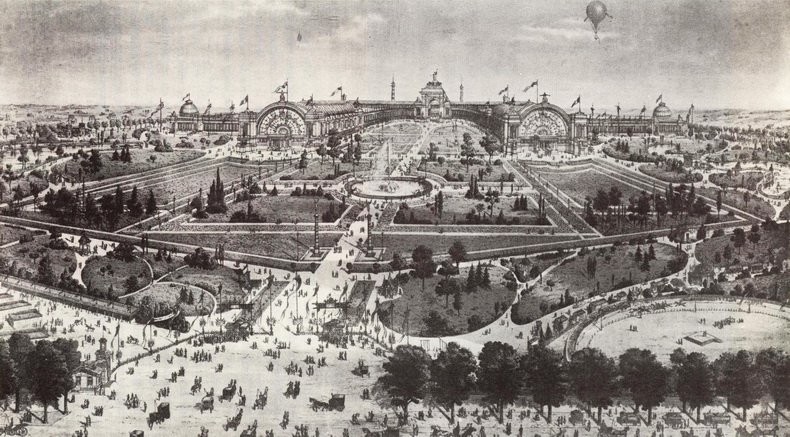
The Brussels International Exposition (French: Exposition Internationale de Bruxelles, Dutch: Wereldtentoonstelling te Brussel) opened on 10 May 1897 and ran through 8 November 1897, drawing an estimated 7.8 million visitors. The Brussels event grew partly out of civic rivalry: a Brussels alderman’s earlier proposal for a fair was refused by the government in 1892, and after Antwerp went ahead with its own exposition in 1894, Brussels resolved to mount one as well. It was financed not by the state but by a private company, “Bruxelles-Exposition,” which struck agreements with the government and issued invitations to participating nations. Sources differ slightly on participation—varying from 22 to 27 in different accounts. The fair’s stated aims were to promote national products without excluding other nations and to shape public opinion in favor of colonization.
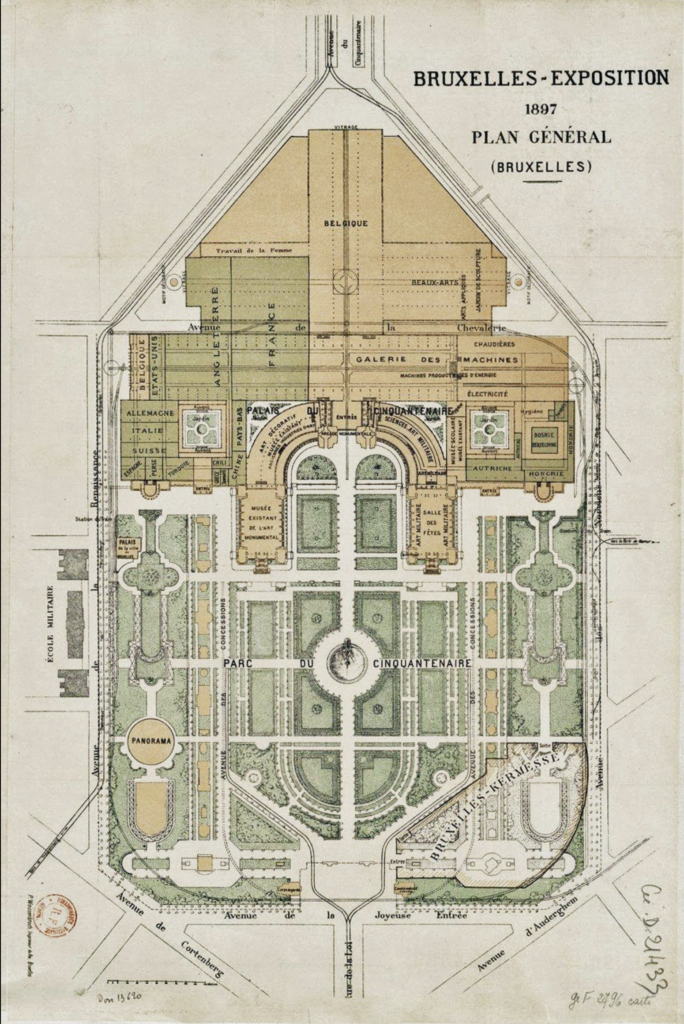
The exposition occupied two sites comprising 14 sections, linked by a purpose-built tramway line and the newly laid-out, roughly 11-km Avenue de Tervueren. The main grounds sat in the Parc du Cinquantenaire/Jubelpark in eastern Brussels, while a second site in the suburb of Tervuren held the colonial section devoted to the Congo Free State, King Leopold II’s personal property. The fair was a showcase of Belgian Art Nouveau at its height: its principal designers included Henry van de Velde, Paul Hankar, Gédéon Bordiau, and Gustave Serrurier-Bovy, and Henri Privat-Livemont produced the posters.
In Tervuren, Leopold II razed the existing Prince of Orange pavilion and erected a Palace of the Colonies in its place. In the main hall, the Hall of the Great Cultures, the decorator Georges Hobé built a distinctive wooden Art Nouveau structure evoking a Congolese forest out of African bilinga wood, and the exhibition displayed ethnographic objects, taxidermied animals, and Congolese export products such as coffee, cacao, and tobacco. The colonial museum functioned largely as a commercial and economic showcase, intended to acquaint Belgian industrialists and artisans with Congo’s raw materials—wood and ivory among the most prized—which Belgian artists worked into chryselephantine sculpture and Art Nouveau furnishings. The Tervueren site also included a replica African village in which 60 Congolese people were made to live for the duration of the exhibition, seven of whom died during their forced stay in Belgium.
Beyond the formal pavilions and colonial exhibits, the fair leaned heavily on spectacle and popular entertainment. The centerpiece amusement was Vieux-Bruxelles (Bruxelles-Kermesse), a 25,000 m² recreated old town offering nostalgic reduced-scale reproductions of historic buildings, dioramas, and the popular Chien-Vert restaurant. The grounds were dotted with novelty attractions of the kind common to Belle Époque fairs: a Cairo panorama pavilion, a “Zoographe” pavilion offering film projections, a giant barrel (the “Tonneau Gigantesque”), a “Giant’s House” (Het Reuzenhuis) built for the De Beukelaer biscuit firm and later reassembled at Bornem, and an infant incubator pavilion. Breweries and refreshment venues such as “Au Chien Vert” and the Borremans brewery catered to visitors alongside a Palais de l’Alimentation. The fair also hosted sporting spectacle: a world wrestling and athletics championship was staged during the exposition, won by the Frenchman Noël Rouveyrolis, known as “Noël le Gaulois.” A new electric tramway, inaugurated in 1897, carried visitors along the Avenue de Tervueren between the two sites, with horse drawn carriages (fiacres) as an alternative.
Physical remnants of the 1897 Exposition are few. After the Exposition closed, Leopold established the Museum of the Congo (today’s Royal Museum for Central Africa) at Tervuren in 1898. Victor Horta’s neoclassical Temple of Human Passions, built to house Jef Lambeaux’s relief, was finished in time but its opening was delayed by disputes until 1899. It is now known as the Horta-Lambeaux Pavilion and is managed by the Royal Museums of Art and History. A part of the surviving Palais Mondial from 1897 has housed the Autoworld automobile museum since 1986.
Lion’s Incubators at the Brussels Exposition
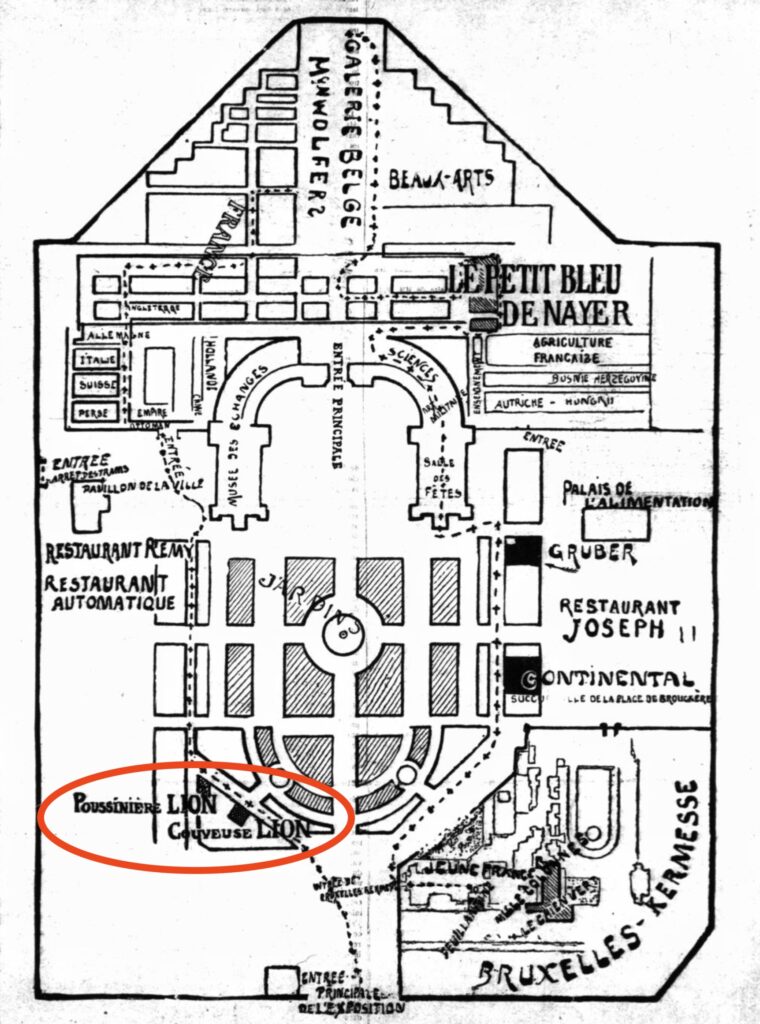
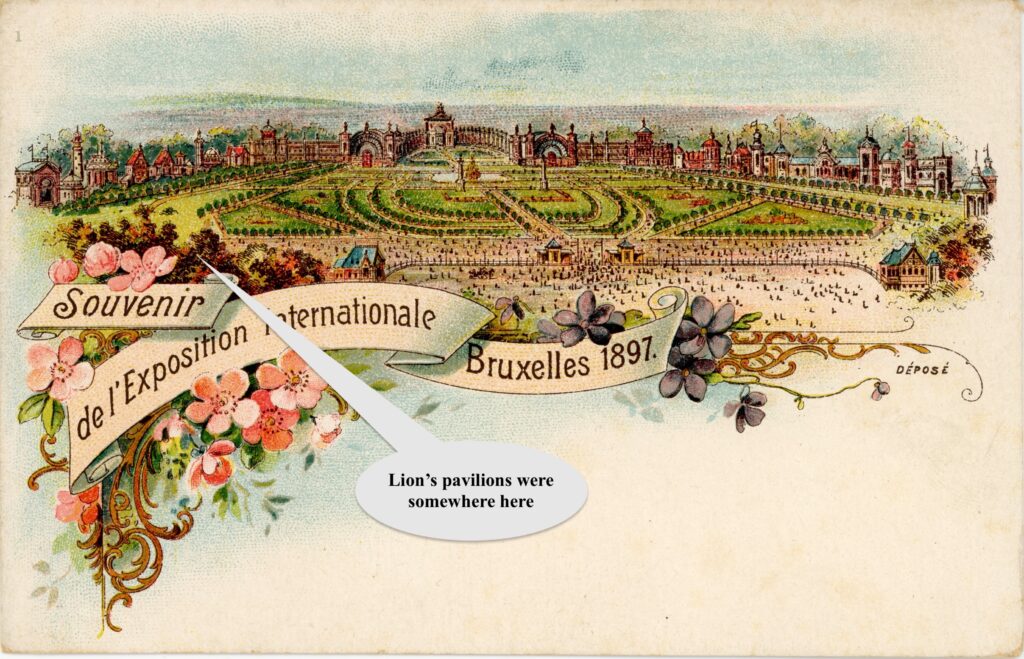
At the Exposition internationale de Bruxelles of 1897, Alexandre Lion mounted two adjacent installations in the left avenue of the gardens, in the Parc du Cinquantenaire: a pavilion of infant incubators operated under the name of his Œuvre maternelle des Couveuses d’Enfants, and, a few metres away, an agricultural incubator — the “couveuse monstre” or Poussinière, capable of holding five thousand eggs with hatchings visible at any hour. Interestingly, some Belgium newspapers focused almost entirely on the infant incubators, while others focused primarily on the poultry incubators, probably reflecting differences in their audience. Admission was not free: a Le Soir notice of 2 September gave the entrance fee to the “Maternité Lion” as 50 centimes, confirming the couveuse as a paying concession, consistent with the ticket-window and queue references elsewhere.

The Incubators in the Belgian Press
The most complete treatment of the infant incubator exhibit came from Le Vingtième Siècle, the Brussels Catholic daily, which devoted a major illustrated feature to Lion’s Œuvre maternelle (May 2, 1897) carrying an engraving of the incubator hall, a portrait of Lion, and a technical drawing of the apparatus. The paper described the device with some precision: a glazed metal cage drawing filtered air from outside and venting through the roof, the temperature held constant by a regulator-thermometer and adjustable by any heat source (gas, oil, petroleum, or electricity). It located the founding of the work in Paris, on the boulevard Poissonnière, dating it to 1891 (it was actually Nice in 1891, Paris came later) and reporting that some thousand children had since been received and saved in the proportion of 82 per cent, with fifty incubators in operation. La Réforme ran its own illustrated feature (May 20), signed with a drawing by Morel, which more accurately rooted the Œuvre Maternelle at Nice and attributed to Dr Ciaudo, the city’s médecin-inspecteur for child protection, a more conservative and specific figure: of about 185 premature infants weighing between 800 grams and 2.9 kilograms over roughly three years, 133 discharged alive and well, 48 dead, 4 still in treatment — a survival rate of 72 per cent.
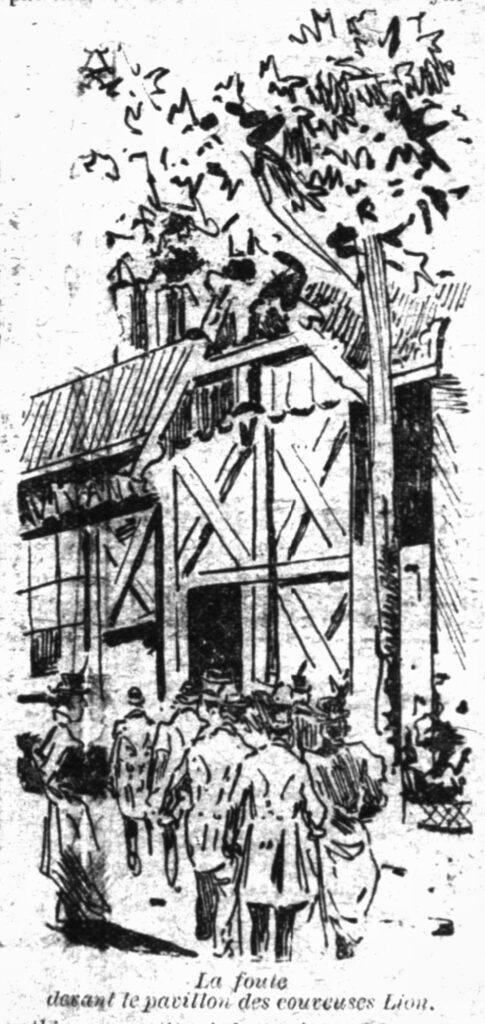
Several papers described the pavilion itself in similar terms: an elegant structure at the head of the left avenue of the Parc du Cinquantenaire, never empty, its façade hung with photographs of babies, synoptic tables and statistics; glazed cases each holding a swaddled premature infant; and, at the rear, a temperature-controlled enclosure where young wet-nurses tended the children. The audience was repeatedly noted as predominantly female. La Réforme‘s “Échos de l’Exposition” recorded a door placard announcing eight premature babies in residence, and the Petit Bleu de l’Exposition — a promotional daily published only for the run of the fair — gave a vivid account under the heading “À la Couveuse d’enfants,” complete with an engraving captioned “La foule devant le pavillon des couveuses Lion.”
The number of infants in the pavilion can be traced across the season, though it fluctuated as children arrived and were discharged rather than rising steadily: four babies in mid-May (Le Vingtième Siècle), six in early August (Petit Bleu, August 9), seven by August 11 (Le Vingtième Siècle), eight including a pair of twins (La Réforme), and nine by early September (Petit Bleu). Two attendance markers also survive: Le Vingtième Siècle reported that Lion celebrated the 200,000th entry into the pavilion with his staff on 10 September, and the Journal de Bruxelles recorded fair-wide entries exceeding 25,000 on a single fine Wednesday in late June.
The poultry incubator exhibit (Poussinière) drew its own coverage, pitched at a different readership. Le Vingtième Siècle (June 27) and the Journal de Bruxelles (June 24) both ran descriptive pieces on the hatching spectacle — five thousand eggs on a sand bed at hen-temperature, chicks and ducklings breaking their shells continuously before the crowd — and both turned the spectacle into advocacy, reporting that agronomes, aviculturists and syndicates had asked Lion to place Poussinières around the country, and that M. Proost, director-general of agriculture and professor at Louvain, had announced a visit. Le Vingtième Siècle‘s earlier feature (June 14) captured the scene at the moment a clutch of ducklings hatched, prompting a child’s cry of “on dirait des serins!” [they look like canaries!]. The Petit Bleu itinerary tied the two exhibits together explicitly, presenting the Poussinière as the device that “admirably completes” Lion’s maternity of infant incubators.
The Exhibit in Popular Culture
A distinct category of coverage references the incubators not as a subject but incidentally, which is itself evidence of how thoroughly the “couveuse d’enfants” had entered the everyday vocabulary of the fair. It served as a geographic landmark in classified advertising — a pavilion for sale “facing the couveuse d’enfants” (Le Soir), a small building “facing the couveuse” destroyed by fire (Journal de Bruxelles, 18 August) — and as a point of reference in news items, including a scaffolding-collapse accident in which an injured carpenter was carried to the infant pavilion and revived by the Croix-Rouge doctor on duty there (Le Peuple). It generated a human-interest item when an abandoned newborn found in the Square Marguerite was delivered by police to the incubators and there revived (Le Courrier de l’Escaut), and it furnished a parliamentary joke when a deputy mocked a government bill as “an infant born before term” fit to be sent “to the Exposition, to the couveuse d’enfants” (Le Peuple, reporting the Chamber). At least one classified advertisement shows the pavilion functioning as a labour exchange, a young woman advertising for a domestic position “on leaving the couveuse d’enfants at the Exposition” (Le Soir). The exhibit’s hold on the public imagination outlasted the fair itself: at the end of December 1897, Le Soir reviewed a Liège revue by Théo Hannon in which the chief attractions of the Brussels World’s Fair — the Chien Vert, the Panorama des Alpes, the Palais de l’Optique, the couveuse d’enfants, the Palais algérien, the Congolais — parade across the stage, the incubator pavilion having become recognizable enough to serve as theatrical shorthand for the Exposition (Le Soir, 31 December 1897).
Alongside these ran the recurring daily squibs that several papers carried with little variation — La Réforme‘s “Le vrai succès de l’Exposition reste toujours la Couveuse d’Enfants,” the Journal de Bruxelles‘s “Le succès de la couveuse d’enfants… s’accentue,” and the standing “Voir à l’Exposition” and listing notices in Le Peuple, Le Soir and Le Vingtième Siècle. These are best understood as a single repeated promotional register rather than as discrete reports, and their volume is itself a measure of how steadily the exhibit was kept before the public eye.
The Incubators in the French Press
The contrast between the Belgian and the French press coverage is striking. In Belgium the infant incubator generated sustained, standalone reporting — descriptive features, an engraved portrait of Lion, running tallies of the babies in residence, the publication of official correspondence, and a parallel advocacy literature around the poultry machine. In the French papers examined, the same exhibit appears only as a single noun in a list of fairground attractions, never as a subject in its own right. La Lanterne (9 October), Le Petit Marseillais and La Gironde (both 10 September) place the “couveuse d’enfants” among the Panorama des Alpes, the zoographe, the optique and the Palais de la ville de Bruxelles, and dispose of the poultry and aviculture concours “pour mémoire” as a matter for specialists. That the Marseille and Bordeaux notices are the same dispatch word for word suggests the limited French interest was largely syndicated wire copy rather than independent reporting — consistent with a French press already turning its attention toward the great Paris exposition of 1900
The Donation to the City of Brussels
La Réform reproduced a pair of official letters under the heading “Les Couveuses d’enfants.” The first, dated June 18, 1897 and signed by the burgomaster Buls for the Collège des bourgmestre et échevins, acknowledges Lion’s letter of 13 June offering incubators to the city’s hospital establishments. The second, dated June 25, from the Conseil général des Hospices et Secours, signed by Van den Broeck and Alfred Evrard, proposes to place one incubator at the hospice de la Maternité and the five remaining at the hospice des Enfants Assistés, and asks Lion’s consent to inscribe him as donor on each. The letters were also reproduced verbatim in Le Vingtième Siècle on July 2, with an added editorial note congratulating Lion for leaving the city’s charitable institutions “un souvenir durable de son passage en Belgique” [a lasting memory of his time in Belgium].
The donated incubators remained in use. Writing in the Gazette de Charleroi in February 1902, Dr. Laigle of Marchienne-au-Pont reported that five “couveuses perfectionnées” were operating regularly in the Service des Enfants Assistés in Brussels. Citing statistics compiled by Dr. Max, chief of the service, he noted that between November 15, 1897 and November 15, 1900, eighty-eight infants weighing from 570 to 2,240 grams were incubated, of whom thirty-eight survived. Survival rose with gestational age: 22 percent of infants born at six months, 25 percent at six and a half months, 45 percent at seven months, and 81.8 percent at seven and a half months; none born before six months survived. By birth weight, no infant under 1,200 grams survived, compared with 45 percent of those weighing 1,200 to 1,500 grams, 62.8 percent of those weighing 1,500 to 2,000 grams, and 70 percent of those above 2,000 grams. Laigle stressed that these outcomes were measured several months after birth, and observed that counting only infants incubated for about a month would have yielded success rates as high as 84 percent for the 1,500 to 2,000 gram group. Although he did not name the maker, the number of incubators and the start of the series a few months after Lion’s gift indicate that these were the units he donated in 1897, making Max’s figures a rare record of how Lion incubators performed in routine hospital use rather than on exhibition.
Awards and Honors
The Rapport Général sur l’Exposition Universelle de Bruxelles 1897 documents that the “Diplome d’Honneur” in Classes 35-41 (various Hygiene) was awarded to “Oeuvre maternelle des couveuses d’enfants, a Paris;” a Collaborateur Silver Medal was awarded to F. Narçon (Lion’s site manager, who also managed the Amsterdam 1895 exhibit); and a Bronze Medal was awarded to Alexandre Lion in Classes 162-163 (Mateéerial agricole) for his poultry incubator.
Interestingly, a gold medal was also awarded to Dr. Ch. Van Aubel, in the Hygiene group, although it is not clear for what. Presumably, it was for his own incubator design, which was quite different than the Lion incubator and was later exhibited at the Dijon Exposition of 1898 and the Paris Exposition of 1900.
Primary Sources
- Rapport Général de l’Exposition internationale de Bruxelles 1897, Chapitre Premier, “Les Jardins — I. Le Parc,” p. 300 — locates “la couveuse artificielle… appliquée à l’espèce humaine” in the left avenue, between the Panorama des Alpes and the restaurant automatique.
- Rapport Général de l’Exposition internationale de Bruxelles 1897: p. 197, Diplômes d’honneur, Oeuvre maternelle des couveuses d’enfants, à Paris; p. 236, Diplômes de médaille de bronze, Lion, Alexandre, à Paris; p. 215, Diplômes de médaille d’argent, Naarçon, F., Oeuvre maternelle des couveuses d’enfants.
- Guide-Album Illustré de l’Exposition Universelle Bruxelles-Tervueren 1897.
- La Vie Moderne à l’Exposition Internationale de Bruxelles 1897
Other Sources
- “Brussels International Exposition (1897),” English Wikipedia. https://en.wikipedia.org/wiki/Brussels_International_Exposition_(1897)
- “Exposition internationale de Bruxelles de 1897,” French Wikipedia. https://fr.wikipedia.org/wiki/Exposition_internationale_de_Bruxelles_de_1897
- “Bruxelles – 1897 – Exposition Internationale,” La Belgique des Quatre Vents (blog), Oct. 2016. https://belgique-insolite-et-occulte.blogspot.com/2016/10/bruxelles-1897-exposition-internationale.html
Belgian Press Sources
Le Courrier de l’Escaut
- 9 July 1897 — “Enfant trouvé”: abandoned newborn taken to the couveuse.
Le Peuple
- 1 June 1897 — “Un accident à l’Exposition”: injured carpenter carried to the infant pavilion.
- 11 July 1897 — Exposition listing (“Maternité Lion” / couveuse monstre).
- 23 July 1897 — “À la Chambre,” séance of 22 July: couveuse d’enfants invoked as a joke.
- 6 September 1897 — Exposition listing.
Le Soir
- 11 June 1897 — classified: pavilion for sale “en face de la couveuse d’enfants.”
- 31 August 1897 — “À l’Exposition”: couveuse monstre notice.
- 2 September 1897 — promotional squib: “couveuses d’enfants avec bébés vivants — Maternité Lion,” admission 50 centimes.
- 7 September 1897 — “À l’Exposition”: closing extended to 7 November; couveuse monstre notice.
- 15 October 1897 — classified: young woman seeking a position on leaving the couveuse.
- 19 October 1897 — “À l’Exposition”: couveuse monstre closing notice.
- 31 December 1897 — “Une revue à Liége” (C.B.): couveuse d’enfants named among the Brussels fair’s attractions parodied in Théo Hannon’s Liège revue.
Le Vingtième Siècle
- 2 May 1897 (2 parts) — illustrated feature on the Œuvre maternelle; apparatus described; Paris/1891, ~82%; home-rearing service; six-incubator donation noted.
- 13 May 1897 (2 parts) — feature on the Couveuses Lion pavilion at inauguration; four babies.
- 14 June 1897 — “À l’Exposition”: ducklings hatching in the couveuse monstre.
- 20 June 1897 — press-fêtes chronicle; visitor tips recommending both exhibits.
- 27 June 1897 — feature on the Poussinière Lion; Proost visit announced.
- 2 July 1897 — reproduces the donation correspondence (letters of 18 June, signed Buls, and 25 June, signed Van den Broeck and Alfred Evrard) on the gift of six incubators; with an editorial note congratulating Lion.
- 5 July 1897 — “À l’Exposition”: recommends aviculturists see the Poussinière.
- 11 August 1897 — crowds in the rain; seven babies in residence.
- 20 August 1897 — “Voir à l’Exposition” listing.
- 10 September 1897 — “À l’Exposition”: 200,000th entry into the pavilion.
- 1 October 1897 — couveuse monstre listing.
- 7 October 1897 — “Voir à l’Exposition” listing.
La Réforme
- 20 May 1897 (2 parts) — illustrated feature “Œuvre maternelle des Couveuses d’enfants” (dessin de Morel); portrait of Lion; Nice origin; Dr Ciaudo statistics (185 infants, 72%).
- 5 June 1897 — “Les fêtes de la Pentecôte”: couveuses listed among attractions.
- 8 June 1897 — “Échos de l’Exposition”: descriptive feature on the pavilion (eight babies; door placard; wet-nurses).
- 24 June 1897 — short note: hundreds daily at the couveuse.
- 30 June 1897 — “Rixe entre deux soldats,” with couveuse note: eight babies (incl. twins) born at 6, 7, 8 months.
- 1 July 1897 (donation correspondence, multiple images) — “Les Couveuses d’enfants”: letters of 18 June (Buls, Collège des bourgmestre et échevins) and 23 June (Van den Broeck and Alfred Evrard, Conseil général des Hospices et Secours) on the gift of six incubators.
- 15 September 1897 — “Le vrai succès de l’Exposition reste toujours la Couveuse d’Enfants.” (recurred with identical wording on many dates throughout the season)
Petit Bleu de l’Exposition (special edition)
- 1 May 1897 (and rerun at intervals through the fair, e.g. 8 August, 4 September, 11 October, 4 November 1897) — “Un itinéraire pratique à l’Exposition”: one-day route; Couveuses and Poussinière adjacency; Dutch railway pavilion opposite; 5,000 eggs hatching publicly
- 19 July 1897 — “Choses qu’il ne faut pas manquer… À l’Exposition”: must-see list including the couveuses and Poussinière Lion.
- 5 September 1897 (multiple images, incl. engraving and site plan) — “À la Couveuse d’enfants”: nine children in residence; exterior photographs/statistics; “La foule devant le pavillon des couveuses Lion”; Exposition site map marking “Couveuse LION” and “Poussinière LION.”
- 3 October 1897 — recurring must-see list (recurred with identical wording on many dates throughout the season)
Journal de Bruxelles
- 24 June 1897 — “À l’Exposition”: feature on the Poussinière; entries over 25,000; Proost visit announced.
- 7 August 1897 (2 images) — “À l’Exposition” section-walk feature on the couveuse; fragment stating the Lion couveuse saves 80%.
- 9 August 1897 — descriptive squib on the couveuses Lion pavilion; six babies in residence; “maternité Lion.”
- 18 August 1897 — “Le succès de la couveuse d’enfants… s’accentue” (recurred with identical wording on many dates throughout the season)
- August 18, 1897 — “Un incendie à l’Exposition,” a small building “en face de la couveuse d’enfants” destroyed by fire
Gazette de Charleroi
- Laigle, Dr. “Les Couveuses d’Enfants.” Gazette de Charleroi, February 22, 1902 (dated Marchienne-au-Pont, February 10, 1902). BelgicaPress, KBR.
French Press Sources
- Le Petit Marseillais, 10 September 1897 — “Exposition internationale de Bruxelles”: couveuse named in an attraction list (syndicated dispatch).
- La Gironde, 10 September 1897 — same syndicated dispatch.
- La Lanterne, 9 October 1897 — “À l’Exposition internationale de Bruxelles”: couveuse d’enfants named in an attraction list.
Internet Links
- Exposition Internationale de Bruxelles – Wikipedia (French)
- Brussels International Exposition (1897) – Wikipedia (English)
- Photos of the Exposition – La Belgique des Quatre Vents
- Brussels International Exposition (1897) – Art and Popular Culture
- Brussels International Exposition (1897) – Grokipedia (a revisionist view of the colonial aspects)
- L’exposition internationale de Bruxelles, 1897. – Le Blog de Callisto (3 parts)
- Exposition Internationale de Bruxelles 1897 – America’s Best History
More Information about Alexandre Lion
- General Information
- Alexandre Lion
- The Lion Incubator
- The Engineer and the Newborns, by W. A. Nelson and Paul L. Toubas
- Lion Patents (France)
- Patent 201550, 1889, Couveuse électro-automatique
- Patent 221716, 1892, Couveuse automatique
- Patent 262090, 1896, Chambre vivifiante
- Patent 281687, 1898, Système de filtration de l’air
- Patent 287557, 1899, Système de filtration des fumées, de l’air et de toutes masses gazeuses avec tirage et ventilation
- Patent 189989, 1899, Appareil pour le filtrage et la purification de l’air et des fumées
- Maternité Lion Institutes and City Exhibits
- Alexandre Lion’s first incubator baby exhibit in Marseille, 1890.
- Œuvre Maternelle des Couveuses d’Enfants, Nice
- Œuvre Maternelle des Couveuses d’Enfants, Lyon
- Œuvre Maternelle des Couveuses d’Enfants, Paris
- Œuvre Maternelle des Couveuses d’Enfants, Toulouse
- Œuvre Maternelle des Couveuses d’Enfants, Amiens
- Œuvre Maternelle des Couveuses d’Enfants, New York
- Œuvre Maternelle des Couveuses d’Enfants, Barcelona
- Œevre Maternelle des Couveuses d’Enfants, Brussels
- Maternité Lion Souvenir Booklets
- Œuvre Maternelle des Couveuses d’Enfants , Paris Institute, Booklet Version #1 (appears to be ~1896)
- Œuvre Maternelle des Couveuses d’Enfants , Paris Institute, Booklet Version #2 (appears to be ~1901)
- Pamphlet from Alexander Lion’s exhibit at the 1898 exhibition in Torino, Italy. (PDF supplied by Dr. Thijs Gras, Amsterdam)
- Press Coverage
- La Maternité “Lion de Nice” pour Enfants Nés Avant Terme ou Débiles, by Dr. Ciaudo, 1895. Source: gallica.bnf.fr.

- Presentation d’Appareil, by M. A. Pinard, Bulletin de l’Académie nationale de médecine, 1893. Source: gallica.bnf.fr.
- Les couveuses d’enfant et le gavage, by César-A Queirolo, Includes discussion of Lion incubator and comparison to other types. Thèse de doctorat: Univ. Genève, 1897.
- Les Couveuses pour Enfants, Gazette Médicale de Paris, No. 40, October 6, 1900
- Couveuses d’Enfants, La Maternité Lion, Paris, La Patrie, 1897
- Paris Letter: An Improved System of Incubators, by O. Jennings, Pediatrics 1:427-428, 1896
- Baby Incubators, The Strand Magazine, 1896, by James Walter Smith
- Human Infant Incubation: A True Fairy-Tale of Modern Science from Leslie’s Weekly, 1897
- The Saving of Human Life, Maternité Lion in NYC, The Literary Digest, 1898
- Immature Infants in France, from The Lancet, January 16, 1897, page 196.
- De Lion Incubator at Low Maternity Hospital, by Francis H. Stuart, Brooklyn Medical Journal, 1901
- Alexandre Lion’s Incubator Charities in Europe (1894–1898) (The Embryo Project)
- La Maternité “Lion de Nice” pour Enfants Nés Avant Terme ou Débiles, by Dr. Ciaudo, 1895. Source: gallica.bnf.fr.
- Worlds Fairs and Expositions
- Maternité Lion at the Lyon Exposition Universelle et Coloniale, 1894
- Maternité Lion at the Lyon Exposition Universelle – Le Monde Illustré, 1894
- Maternité Lion at the Bordeaux Exposition of 1895.
- “La Maternité Lion,” by Louis Énault, Journal of the Bordeaux Exposition, 1895
- Maternité Lion at the Amsterdam World Exposition, 1895
- Maternité Lion at the Berliner Gewerbeausstellung, 1896
- “Bericht ǔber die Couveuse (Lion) oder Kinderbrutanstalt” [Report about the Lion Incubator] from Berlin und seine Arbeit – Amtlicher Bericht der Berliner Gewerbe-Ausstellung 1896. English Translation.
- Maternité Lion at the Exposition National Suisse, Geneva, Switzerland, 1896
- “Quelques Réflexions sur le Fonctionnement et les Résultats des Couveuses Lion pendant l’Exposition Nationale,” by Dr. Hector Maillart, Revue Médicale de La Suisse Romande, 1896. English translation.
- Internationale Ausstellung für Körperliche Erziehung, Gesundheitspflege und Sport, Innsbruck, 1896
- Maternité Lion at the Tennessee Centennial Exposition, 1897
- Maternité Lion at the Brussels International Exposition, 1897
- Maternité Lion at the Turin L’Esposizione Generale Italiana, 1898
- Maternite Lion at the Ghent Provincial Exposition of 1899
- Maternité Lion at the Greater Britain Exhibition of 1899
- Maternité Lion at the Paris Exposition Universelle of 1900
- Maternité Lion at the Woman’s Exhibition in Earls Court, London, 1900
- Maternité Lion at the Lille Exposition of 1902
- Maternité Lion at the Exposition Internationale de Reims, 1903
- Maternité Lion at the Nantes Exposition of 1904
- Maternité Lion at the Exposition du Nord de la France, 1904
- Maternité Lion at the Liège Exposition Universelle et Internationale, 1905.
- Maternité Lion at the Marseille Colonial Exposition of 1906
- Maternite Lion at the Bordeaux International Maritime Exposition of 1907
- Maternité Lion at the Marseille Exposition Internationale d’Électricité, 1908
- Maternité Lion at the Exposition Internationale de l’Est de la France, Nancy, France, 1909
- Maternité Lion at the Brussels Exposition Universelle et Internationale, 1910
- Maternite Lion at the Exposition du Centre de la France, Clermont-Ferrand, 1910
- Maternité Liion at the Rome International Exposition of 1911
- Maternité Lion at the Turin International Exposition of 1911
- Maternité Lion at the Exposition Internationale de Dunkerque, 1912
- Maternité Lion at the Ghent International Exposition of 1913
- Maternité Lion at the Exposition Internationale Urbaine de Lyon, 1914
- Maternité Lion at the Lyon Exposition Universelle et Coloniale, 1894
French primary sources were machine-translated, then checked against the originals and edited by the author. Portions of this page were drafted with machine assistance; the final text was reviewed, verified, and edited by the author. Click here to learn more.
Last Updated on 10/01/26