Exposition de Nantes 1904
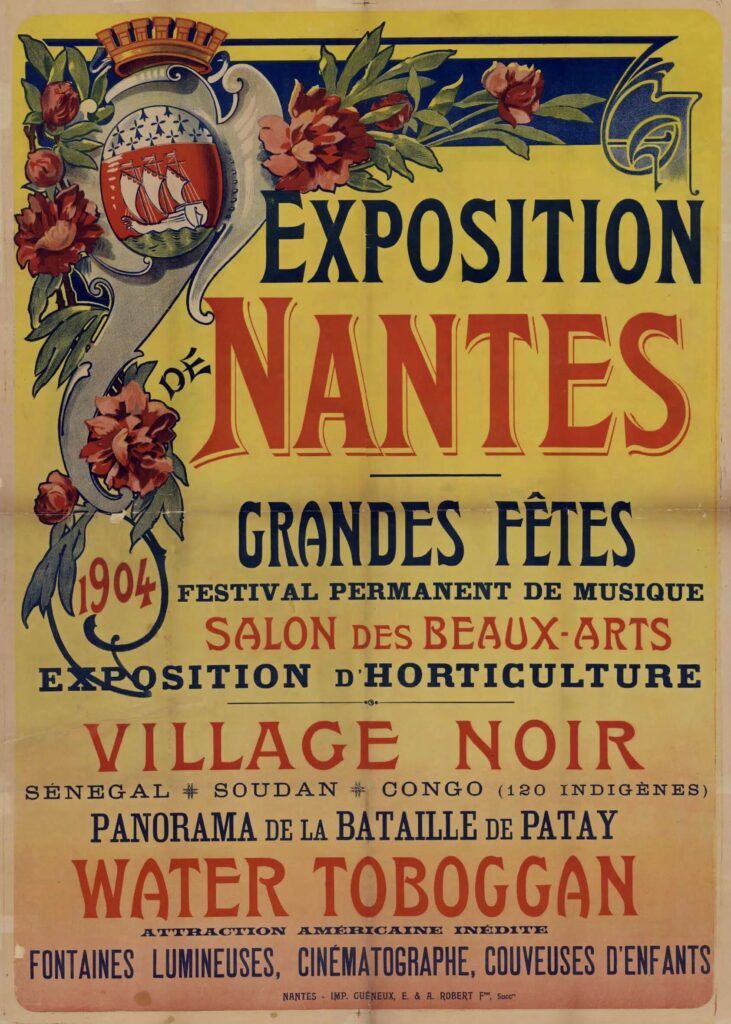
The Exposition de Nantes of 1904 was an international industrial and commercial exposition held on the Champ de Mars in Nantes, its grounds extending toward the left bank of the Loire. It was organized by Jean-Alfred Vigé, a French entertainment entrepreneur involved with many expositions of that era, and opened around 12 May 1904 (the date of the first issue of its official weekly gazette, Nantes-exposition); it ran through the summer to a close given as 9 October 1904 in the BnF catalogue and repeated in the secondary literature, though a primary clôture report has not yet been located. An earlier announcement in La Locomotion Automobile (December 1903) had provisionally advertised 8 May–15 September, so both endpoints shifted as the plans firmed up and the successful run was extended into the autumn. Like the contemporaneous Exposition du Nord de la France at Arras (1 May–4 October 1904), it belonged to the wave of ambitious provincial expositions that followed the 1900 Paris model.
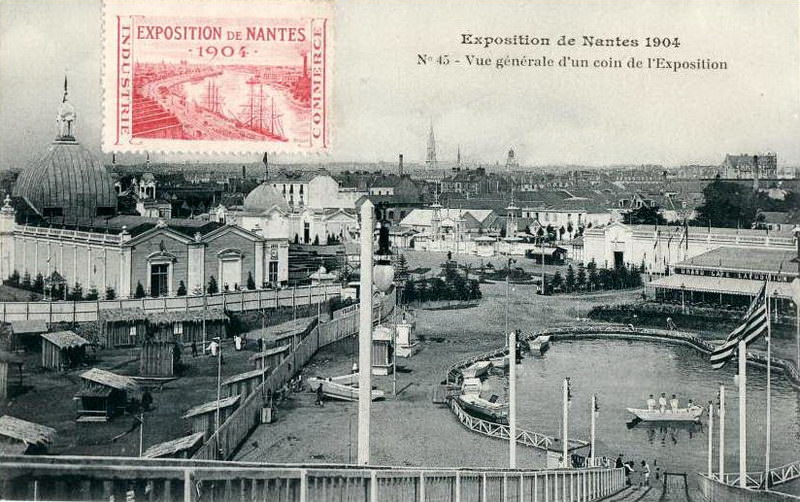
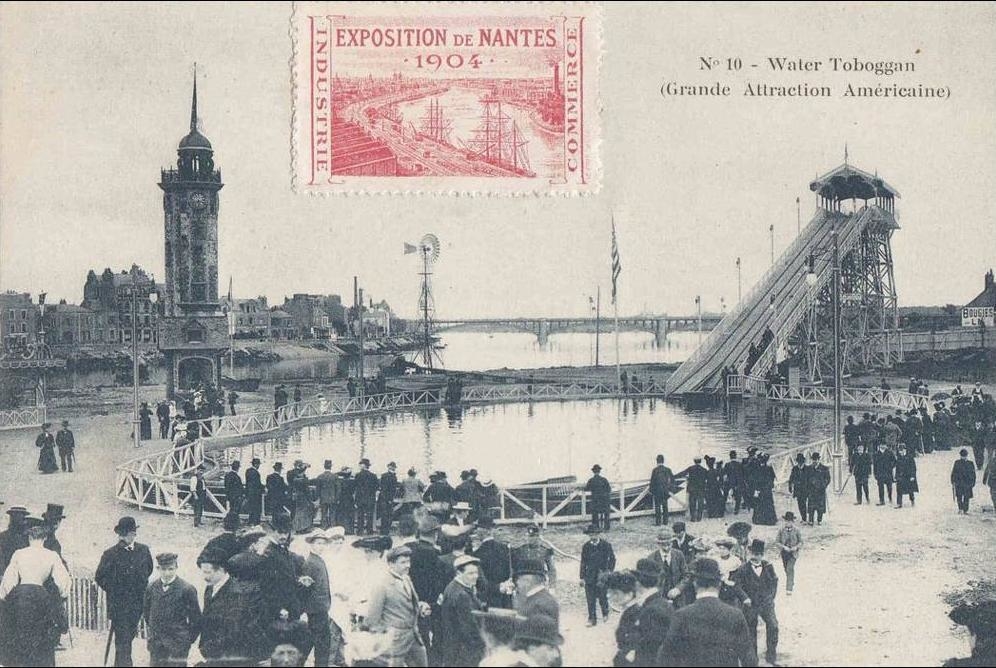
The exposition combined themed palaces — industry and commerce, Beaux-Arts, hygiene and alimentation, the liberal arts, and a dedicated automobile palace — with commercial pavilions, including one for the Nantes biscuit firm Lefèvre-Utile (LU). Its billed attractions, advertised on the official poster, ranged from a permanent music festival, a salon des Beaux-Arts, and a horticultural show to a giant “water-toboggan” promoted as an unprecedented American novelty, luminous fountains, a cinematograph, a panorama of the Battle of Patay, and an incubator baby exhibit (couveuses d’enfants). Like many other expositions of that era, it included a “village noir”: a colonial ethnographic display of roughly 120 Africans, mostly Senegalese, staged under the direction of the Franco-Senegalese Jean Thiam, and now the best-documented and most-studied aspect of the event.
Among the recurring crowd-draws were the summer fêtes aérostatiques (balloon ascensions), which began on 14 July with the balloon La Bretagne piloted by the well-known aeronaut Nicolleau, followed by flights of the 800 m³ balloon Exposition by the local pharmacist-aeronaut Edmond David on 24 July and again on 1 and 15 August. Daily attendance was substantial, with the local paper Le Populaire citing figures on the order of 30,000 for peak days. The principal primary source for the exposition is its own official gazette, Nantes-exposition (N° 1–20, 12 May–24 September 1904), which survives only on paper at the BnF (Tolbiac, FOL-V-4866) and, incompletely, at the Bibliothèque de l’Arsenal.
Alexandre Lion’s Couveuses d’Enfants at the Exposition de Nantes (1904)
Among the attractions of the Exposition internationale de Nantes (Champ de Mars, 12 May–9 October 1904) was an installation of infant incubators — couveuses d’enfants — exhibiting living premature babies. The contemporary press identifies it without ambiguity as a Lion enterprise: “la couveuse Lion,” “les couveuses d’enfants de M. Lion.” It was among the exposition’s most-visited features, repeatedly ranked with the water-toboggan and the “village noir” as one of the event’s principal draws, and more than once called “un ‘clou’ de l’Exposition” — a star attraction.
The pavilion stood just beyond the Palais des Arts libéraux. Describing it on 27 June, Le Nouvelliste de l’Ouest reported two incubators in operation, each warming an infant, with cards (fiches) mounted at the head of each apparatus recording the child’s gradual weight gain from the day it was placed inside. The exhibit’s appeal, uniformly, was that the babies were real and alive — “plusieurs bébés vivants,” or, as the British press put it, “alive and kicking.” Individual infants were followed in print: Le Phare de la Loire (15 June) noted a baby that had weighed 800 grams on arrival and was gaining steadily; René de Chavagnes, in a column syndicated to La France and Le Ruy Blas (23 July), recorded — half-mockingly — a baby “engraissé de 640 grammes en sept semaines” (640 g gained in seven weeks); Le Nouvelliste (27 June) described one infant near term and another younger still.
From the opening weeks through the close, the couveuses drew steady crowds. Le Phare de la Loire reported the establishment “n’a pas désempli de la journée” — never emptied all day, visitors leaving amazed (2 August). Reminders to go and see it recur through June, July, and August; as late as 2 October the paper looked back on it as “un des endroits les plus intéressants de l’Exposition.” The coverage consistently framed it two ways at once — a curiosité and an œuvre humanitaire, an “établissement modèle, unique en son genre.” At the official inauguration reported by the Journal des débats (28 June), the cortège of the préfet (Hélitas) and the mayor (Sarradin) toured the couveuses as part of the formal circuit, a mark of institutional endorsement.
Several Paris papers used the Nantes exhibit to profile Lion’s larger operation. L’Écho de Paris (7 June, Paul Lewis) and Le Journal (7 June, Jean d’Yvelet) both credit the “couveuse Lion” with having saved 5,000 premature infants, and both report that Lion’s Paris establishment — formerly at the boulevard Poissonnière address — had recently been relocated to 23 avenue Daumesnil, Saint-Mandé (Seine), at the edge of the Bois de Vincennes, under the medical direction of a Dr. Bourdon. The establishment offered both free and for-payment services, and even the rental of an incubator at home so that a mother need not be separated from her child. Le Journal specifies financial support from the French ministère de l’intérieur.
The London Daily News carried an account from its Paris correspondent (14 June, datelined “Paris, Monday” = 13 June): the “Couveuse Lion,” credited on scientific authority with saving at least five thousand infant lives; the “Villa Maternelle,” established in Paris and “exhibited at Arras”; and the exhibits in the couveuse show “real babies, alive and kicking.” It adds that Lion’s work had been officially recognised “by the Prime Minister… by a subvention” — reconcilable with Le Journal‘s “subvention du ministère de l’intérieur,” since Émile Combes held both the premiership and the Interior portfolio in 1904, so the two descriptions point to the same office. This single Daily News dispatch propagated widely across the anglophone press over the following weeks — in England (Sunderland Daily Echo, 15 June; Manchester City News, 18 June), Ireland (Evening Herald, Dublin, 14 June), and Australia (Brisbane Telegraph, 13 Aug; Daily Record, Rockhampton, 6 Aug; Inverell Times, 31 Aug; Narromine News and Trangie Advocate, 2 Sept) — a striking measure of international reach for a regional French exposition, all of it traceable to one Paris correspondent’s report.
Crucially for the record, these same sources establish that Lion was running two exhibits simultaneously in 1904 — Nantes and Arras (Exposition du Nord de la France). Le Journal saw the same couveuse “également à l’Exposition d’Arras, qui bat son plein en ce moment,” and the Daily News confirms that Lion’s couveuse was likewise “exhibited at Arras.” Lion is described as touring his couveuse across France to spread its benefits — a detail that places Nantes and Arras firmly on his 1904 itinerary.
Throughout the coverage he is “l’inventeur, M. Lion” — never “Dr Lion.” The physician of record is Bourdon. This is consistent with Lion’s standing as an engineer rather than a physician, and a refreshing contrast to the honorific inflation (“Dr Lion”) found in many press accounts. As a measure of the exhibit’s fame, a Nantes clothing house, the Pont-Neuf (20 rue d’Orléans), borrowed it as an advertising hook, running a display ad headed “L’Exposition et les couveuses d’enfants” (26 June) to sell children’s clothes on the strength of the couveuses’ celebrity.
Unfortunately, I have not been able to find any photographs or Lion’s usual souvenir postcards or booklets for his exhibit at the Nantes Exposition to date, but as additional resources are digitized, some may turn up eventually.
French primary sources were machine-translated, then checked against the originals and edited by the author. Portions of this page were drafted with machine assistance; the final text was reviewed, verified, and edited by the author.
Internet sources:
- Archives de Nantes – Les fêtes aérostatiques de l’Exposition de 1904
- Cartes postales anciennes de Nantes
- Le village noir à l’exposition de Nantes de 1904 en histoire et en images Source: Persée
- La Locomotion Automobile – December 1903 – L’Exposition de Nantes 1904
Press sources (chronological):
- L’Écho de Paris, 7 June 1904 (Paul Lewis, “À Nantes — Visite à l’Exposition”).
- Le Journal, 7 June 1904 (Jean d’Yvelet, “Paris-Nantes-Express”).
- The Daily News (London), 14 June 1904, p. 8 (“Baby ‘Incubators’ at the Nantes Exhibition,” from the Paris correspondent, datelined 13 June) — parent of the anglophone coverage. Reprinted, in whole or trimmed, in: Evening Herald (Dublin), 14 June 1904; Sunderland Daily Echo, 15 June 1904; Manchester City News, 18 June 1904; Daily Record (Rockhampton, Queensland), 6 August 1904; Brisbane Telegraph, 13 August 1904; Inverell Times (NSW), 31 August 1904; Narromine News and Trangie Advocate (NSW), 2 September 1904.
- Le Phare de la Loire, 15 June 1904 (“La Vie à Nantes — À l’Exposition”).
- Le Phare de la Loire, 26 June 1904 (Pont-Neuf advertisement, “L’Exposition et les couveuses d’enfants”).
- Le Nouvelliste de l’Ouest, 27 June 1904.
- Journal des débats politiques et littéraires, 28 June 1904 (A. Le M…, “Nouvelles du jour — L’Exposition de Nantes”).
- Le Phare de la Loire, 3 July 1904.
- Le Phare de la Loire, 19 July 1904 (“Chronique locale — À l’Exposition”).
- La France, 23 July 1904 (René de Chavagnes, “Carnet de l’observateur — Nantes et son Exposition”).
- Le Ruy Blas, 23 July 1904 (René de Chavagnes, same column, syndicated).
- Le Phare de la Loire, 2 August 1904.
- Le Phare de la Loire, 7 August 1904.
- Le Phare de la Loire, 21 August 1904.
- Le Phare de la Loire, 2 October 1904.
More Information about Alexandre Lion
- General Information
- Alexandre Lion
- The Lion Incubator
- The Engineer and the Newborns, by W. A. Nelson and Paul L. Toubas
- Lion Patents (France)
- Patent 201550, 1889, Couveuse électro-automatique
- Patent 221716, 1892, Couveuse automatique
- Patent 262090, 1896, Chambre vivifiante
- Patent 281687, 1898, Système de filtration de l’air
- Patent 287557, 1899, Système de filtration des fumées, de l’air et de toutes masses gazeuses avec tirage et ventilation
- Patent 189989, 1899, Appareil pour le filtrage et la purification de l’air et des fumées
- Maternité Lion Institutes
- Alexandre Lion’s first incubator baby exhibit in Marseille, 1890.
- Oeuvre Maternelle des Couveuses d’Enfants, Nice
- Oeuvre Maternelle des Couveuses d’Enfants, Lyon
- Oeuvre Maternelle des Couveuses d’Enfants, Paris
- Oeuvre Maternelle des Couveuses d’Enfants, New York
- Oeuvre Maternelle des Couveuses d’Enfants, Barcelona
- Ouevre Maternelle des Couveuses d’Enfants, Brussels
- Maternité Lion Souvenir Booklets
- Oeuvre Maternelle des Couveuses d’Enfants , Paris Institute, Booklet Version #1 (appears to be ~1896)
- Oeuvre Maternelle des Couveuses d’Enfants , Paris Institute, Booklet Version #2 (appears to be ~1901)
- Pamphlet from Alexander Lion’s exhibit at the 1898 exhibition in Torino, Italy. (PDF supplied by Dr. Thijs Gras, Amsterdam)
- Press Coverage
- La Maternité “Lion de Nice” pour Enfants Nés Avant Terme ou Débiles, by Dr. Ciaudo, 1895. Source: gallica.bnf.fr.

- Presentation d’Appareil, by M. A. Pinard, Bulletin de l’Académie nationale de médecine, 1893. Source: gallica.bnf.fr.
- Les couveuses d’enfant et le gavage, by César-A Queirolo, Includes discussion of Lion incubator and comparison to other types. Thèse de doctorat: Univ. Genève, 1897.
- Les Couveuses pour Enfants, Gazette Médicale de Paris, No. 40, October 6, 1900
- Couveuses d’Enfants, La Maternité Lion, Paris, La Patrie, 1897
- Paris Letter: An Improved System of Incubators, by O. Jennings, Pediatrics 1:427-428, 1896
- Baby Incubators, The Strand Magazine, 1896, by James Walter Smith
- Human Infant Incubation: A True Fairy-Tale of Modern Science from Leslie’s Weekly, 1897
- The Saving of Human Life, Maternité Lion in NYC, The Literary Digest, 1898
- Immature Infants in France, from The Lancet, January 16, 1897, page 196.
- Alexandre Lion’s Incubator Charities in Europe (1894–1898) (The Embryo Project)
- La Maternité “Lion de Nice” pour Enfants Nés Avant Terme ou Débiles, by Dr. Ciaudo, 1895. Source: gallica.bnf.fr.
- Worlds Fairs and Expositions
- Maternité Lion at the Lyon Exposition Universelle et Coloniale, 1894
- Maternité Lion at the Bordeaux Exposition of 1895.
- “La Maternité Lion,” by Louis Énault, Journal of the Bordeaux Exposition, 1895
- Maternité Lion at the Amsterdam World Exposition, 1895
- Maternité Lion at the Berliner Gewerbeausstellung, 1896
- “Bericht ǔber die Couveuse (Lion) oder Kinderbrutanstalt” [Report about the Lion Incubator] from Berlin und seine Arbeit – Amtlicher Bericht der Berliner Gewerbe-Ausstellung 1896. English Translation.
- Maternité Lion at the Exposition National Suisse, Geneva, Switzerland, 1896
- “Quelques Réflexions sur le Fonctionnement et les Résultats des Couveuses Lion pendant l’Exposition Nationale,” by Dr. Hector Maillart, Revue Médicale de La Suisse Romande, 1896. English translation.
- Maternité Lion at the Tennessee Centennial Exposition, 1897
- Maternité Lion at the Brussels International Exposition, 1897
- Maternité Lion at the Turin L’Esposizione Generale Italiana, 1898
- Maternite Lion at the Ghent Provincial Exposition of 1899
- Maternité Lion at the Greater Britain Exhibition of 1899
- Maternité Lion at the Paris Exposition Universelle of 1900
- Maternité Lion at the Woman’s Exhibition in Earls Court, London, 1900
- Maternité Lion at the Lille Exposition of 1902
- Maternité Lion at the Exposition Internationale de Reims, 1903
- Maternité Lion at the Nantes Exposition of 1904
- Maternité Lion at the Exposition du Nord de la France, 1904
- Maternité Lion at the Liège Exposition Universelle et Internationale, 1905.
- Maternité Lion at the Marseille Colonial Exposition of 1906
- Maternite Lion at the Bordeaux International Maritime Exposition of 1907
- Maternité Lion at the Marseille Exposition Internationale d’Électricité, 1908
- Maternité Lion at the Exposition Internationale de l’Est de la France, Nancy, France, 1909
- Maternité Lion at the Brussels Exposition Universelle et Internationale, 1910
- Maternite Lion at the Exposition du Centre de la France, Clermont-Ferrand, 1910
- Maternité Liion at the Rome International Exposition of 1911
- Maternité Lion at the Turin International Exposition of 1911
- Maternité Lion at the Exposition Internationale de Dunkerque, 1912
- Maternité Lion at the Ghent International Exposition of 1913
- Maternité Lion at the Exposition Internationale Urbaine de Lyon, 1914
Last Updated on 07/20/26