L’Esposizione Generale Italiana del 1898
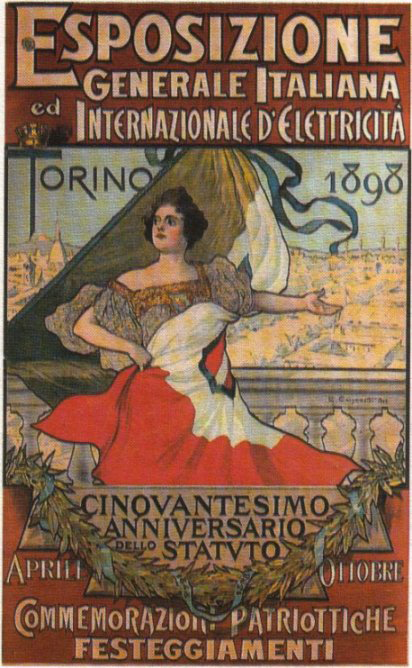
The Esposizione Generale Italiana was held in Turin from May 1 to November 20, 1898 to mark the fiftieth anniversary of the Statuto Albertino. King Carlo Alberto granted the Statute to the Kingdom of Sardinia in 1848, and it remained the constitution of united Italy from 1861 until 1948. The idea began modestly in 1895, when a workers’ association proposed an exhibition of the “forze vive dell’operaio” (the active strengths of the working man). A citizens’ committee led by the deputy Tommaso Villa soon expanded it into a general national exposition, with the Duke of Aosta as president of the general committee. King Umberto I and Queen Margherita opened the exposition on Sunday, May 1, 1898, in the Salone dei Concerti, where Arturo Toscanini conducted an inaugural cantata by Luigi Mancinelli. The organizers presented it as a celebration of fifty years of constitutional liberty and of Italy’s industrial take-off.
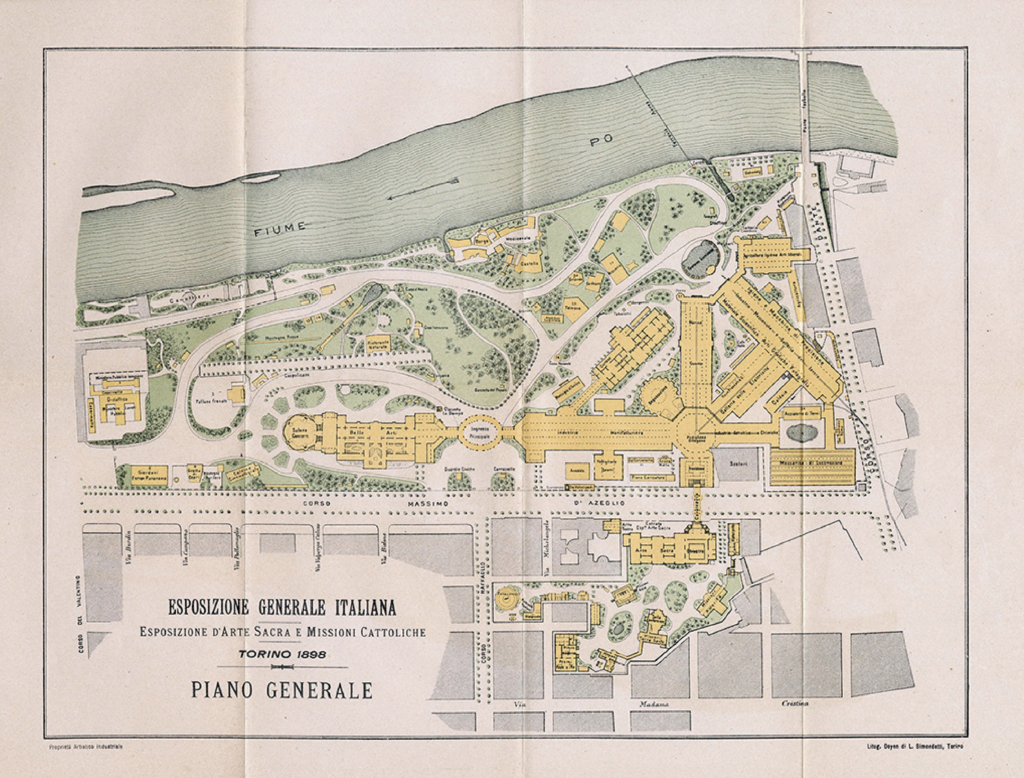
The exposition occupied about 85,000 square meters of the Valentino park on the bank of the Po, between the Valentino castle and the Ponte Isabella. The architects Carlo Ceppi, Costantino Gilodi and Giacomo Salvadori designed its temporary “city of wood, iron and plaster” in a mix of Neo-Baroque, Neo-Moorish and Neo-Rococo styles. Its landmarks included:
- an elliptical colonnaded main entrance on Corso Raffaello
- the domed Rotonda dei Concerti
- the Octagon pavilion
- a monumental fountain of the twelve months
- a Moorish triple façade facing the river
- the vast, tunnel-like Galleria del Lavoro, where working machinery was on display
A loggia bridge, the Ponte della Concordia, linked the grounds to a separate Exposition of Sacred Art and Catholic Missions. Placing a secular and a religious exposition side by side was new. The Shroud of Turin was placed on public view (25 May–2 June), and on 28 May the amateur photographer Secondo Pia made the first photographs of it, discovering that his glass-plate negative showed a strikingly lifelike positive image, which meant the image on the cloth itself has the light-dark reversal of a photographic negative. This is now the best-remembered event of the 1898 exposition. Wood salvaged from the demolished buildings was later reused in the Italian pavilion that the same three architects designed for the Paris Exposition Universelle of 1900.
The exposition had about 8,000 exhibitors and hosted 43 national and international congresses. The Fine Arts Division showed work by 147 Italian artists, five of them women. Foreign firms were admitted only to the Electricity Gallery, which housed an International Electricity Exhibition, and to the Galleria del Lavoro for branches of mechanical engineering not yet developed in Italy. Marconi’s wireless telegraph was demonstrated in the Navy gallery.
An amusement park offered, among other attractions:
- a rowing trip through a replica of Capri’s Blue Grotto
- a walk through half a kilometer of mock California gold-mine tunnels
- a “panorama railway” that simulated a journey to Naples, and later to Switzerland
- an Egyptian pavilion
- a troupe of “Dahomey Amazons” camped near the Ponte Isabella
The exposition opened amid serious social unrest. Six days after the inauguration, General Bava-Beccaris turned artillery on protesters in Milan, and the organizers were careful to present Turin as a showcase of order and productive labor. The prize ceremony was held in the Salone Verdi on 30 October 1898. The exposition drew 2,972,132 visitors between May 1 and November 20, according to the organizing committee’s final count (La Stampa, November 21, 1898).*
The Incubator Exhibit
Alexandre Lion had a large exhibit of incubators with live babies in a dedicated building. A comprehensive booklet about the incubators and the care and feeding of the babies was distributed to visitors.
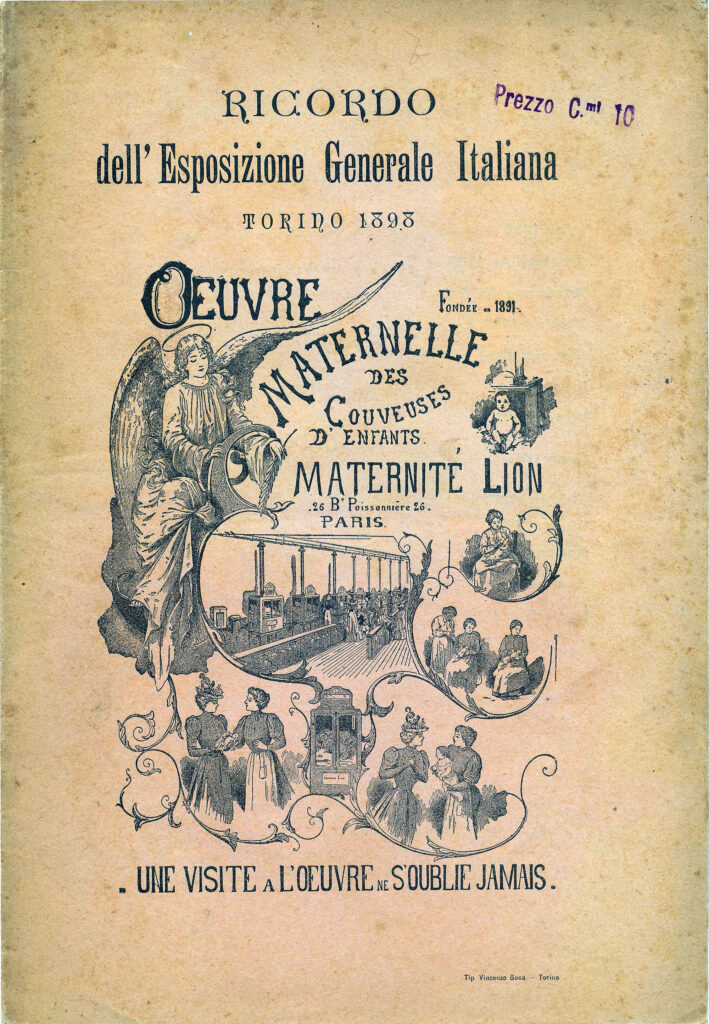
The first mention I have found of Lion’s pavilion by the daily press was in La Stampa on May 20, 1898 (reprinted in La Patria del Friuli in Udine on May 24, 1898):
Le incubatrici per bambini.
Una novità molto interessante all’Esposizione è rappresentata dalle incubatrici per bambini nati prematuramente.
In un grazioso padiglione a sinistra del Salone dei concerti, si osservano sei apparecchi costituiti essenzialmente di un parallelepipedo in metallo, la cui facciata anteriore è munita di una porta a vetri. In ciascuno di essi è contenuto un bambino, il quale si trova, per il funzionamento di un ingegnoso meccanismo, in un ambiente a temperatura elevata, mantenuta costantemente ad un grado determinato da un regolatore automatico. L’aria che il bambino respira è presa fuori del locale e arriva nell’apparecchio dopo essersi filtrata attraverso uno spesso strato di cotone sterilizzato, su cui depone tutte le impurità in essa sospese.
Scopo di questo apparecchio si è di rianimare e tenere in vita i bambini nati prima che siano trascorsi i nove mesi di gestazione. Queste deboli creature rappresentano, a quanto affermano i medici, dal 16 al 30 [?] 0/0 delle nascite, e per la massima parte muoiono entro il 1° mese di vita, mentre la incubatrice le fa sopravvivere.
— La Stampa, May 20, 1898
The infant incubators.
A very interesting novelty at the Exposition is the incubators for prematurely born infants.
In an attractive pavilion to the left of the concert hall, one can see six apparatuses, each consisting essentially of a metal box whose front is fitted with a glass door. Each contains one infant, who, by means of an ingenious mechanism, is kept at a raised temperature, held constant at a set level by an automatic regulator. The air the infant breathes is drawn from outside the building and reaches the apparatus after being filtered through a thick layer of sterilized cotton, which traps all the impurities suspended in it.
The purpose of this apparatus is to revive and keep alive infants born before the nine months of gestation have passed. These frail creatures make up, according to physicians, 16 to 30 percent of births, and most of them die within the first month of life, whereas the incubator enables them to survive.
— La Stampa, May 20, 1898
The incubator pavilion first appears in La Stampa‘s daily exposition program (‘La giornata d’oggi’) on June 12, 1898, about six weeks after the exposition opened, and was present in the section whenever it appeared until the last “La giornata d’oggi” listing on November 17, 1898.
Incubatrici per bambini. — Dalle ore 8 alle 23, chiosco a sinistra del Salone G. Verdi all’Esposizione.
— La Stampa, June 12, 1898
Infant incubators. — From 8 a.m. to 11 p.m., kiosk to the left of the G. Verdi Hall at the Exhibition.
— La Stampa, June 12, 1898
On June 19, 1898, L’Illustrazione Italiana ran a full-page illustrated article by E. Minneci di Villareal on the incubator exhibit of “Alessandro Lion di Parigi” at the Turin exposition. It described an attractive Swiss-chalet pavilion near the concert hall, whose awning advertised “Incubatrici per bambini vivi.” Inside, six incubators stood against one wall behind a rail, with two small rooms at the back for the wet nurses who fed the infants. Babies too weak to suckle were fed through the nose with a special spoon. A Turin physician, Dr. Ed. Testera, was in charge of the medical care. Each incubator was a metal box about 70 by 47 cm, with a double glass door and side windows. Fresh air was drawn from outside through a filter of sterilized cotton, warmed by a thermosiphon that could run on gas, electricity or petroleum, and held at a set temperature by Lion’s automatic regulator. For sick infants the air could be medicated with turpentine, ozone or oxygen. The article was illustrated with Lion’s portrait, the exterior of the pavilion, a nurse tending an infant, and a view of the interior with visitors.
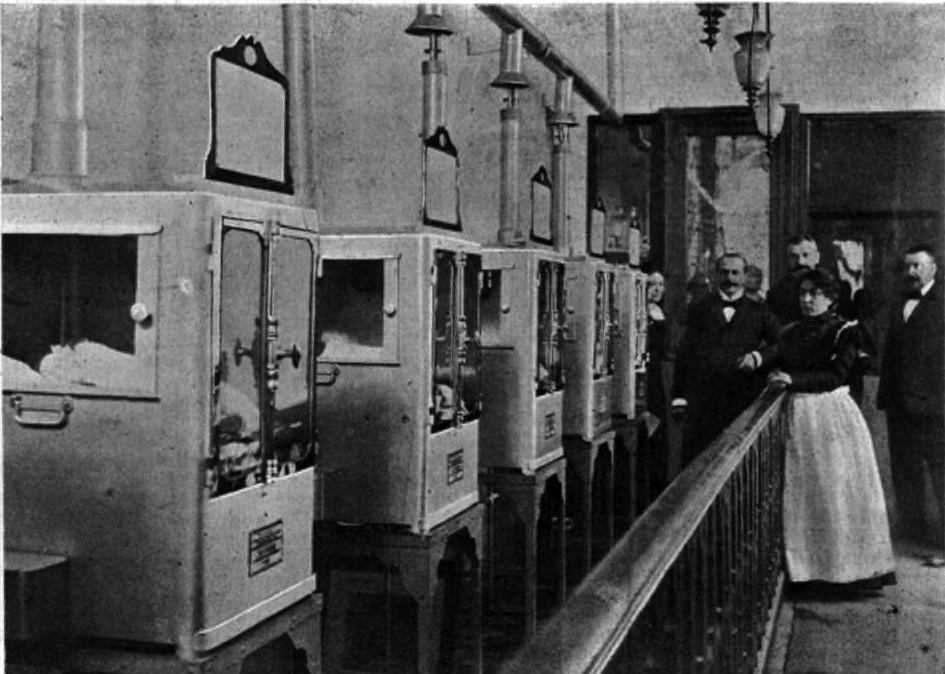
The article presented Lion as a humanitarian inventor. It claimed that where 80 percent of premature infants had once died, 80 percent now survived, and cited Dr. Ciaudo of Nice for an 82 percent survival rate. It listed Lion’s prizes at earlier expositions, Pinard’s presentation of the incubator to the Paris Académie de médecine, Vallin’s praise of it at the Académie in November 1895, and a subsidy from the French Ministry of the Interior on the recommendation of Henri Monod. It also named Lion’s institutes across Europe and the Americas. Two details are new for Turin: on arriving, Lion donated four incubators to the city’s Royal Maternity Hospital, directed by Dr. Carbonelli, so that Turin would be the first Italian city to test them; and the pavilion was visited at length by the Prince and Princess of Naples, Princess Letizia, and the Dukes and Duchesses of Aosta and Genoa. The article closed by describing a steady stream of visitors, “numerous and moved,” at what it called one of the finest humanitarian discoveries of the century.
La Stampa returned to the incubators on July 19th, naming Lion and referencing the French trade name for his exhibit:
« Les couveuses d’enfants ».
Il padiglione delle incubatrici per bambini, del signor Lion, è sempre affollato, e il pubblico d’ogni ceto dimostra di prendere moltissimo interesse all’opera veramente umanitaria del signor Lion, e le sei piccole creature ricoverate in questo padiglione sono oggetto di profonde riflessioni e di discorsi improntati ad una vera e propria commozione, specialmente da parte delle numerose visitatrici. Ed è davvero commovente il pensiero che queste fragili creature, nate per la maggior parte a meno di sette mesi di gestazione, con un peso iniziale che rappresentava la metà, e per alcuni perfino un terzo del peso ordinario dei bambini nati a termine (e che nelle condizioni ordinarie sarebbero indubbiamente morte), non solo vivono, ma crescono e si sviluppano nelle stesse proporzioni dei bambini normali.
— La Stampa, July 19, 1898
“Les couveuses d’enfants.”
Mr. Lion’s pavilion of infant incubators is always crowded, and the public of every class shows the greatest interest in Mr. Lion’s truly humanitarian work. The six little creatures sheltered in this pavilion are the subject of deep reflection and of talk marked by genuine emotion, especially among the many women visitors. And it is truly moving to think that these fragile creatures, most of them born at less than seven months’ gestation, with a birth weight half, and for some even a third, of the normal weight of full-term infants (and who under ordinary conditions would undoubtedly have died), not only live but grow and develop at the same rate as normal infants.
— La Stampa, July 19, 1898
Abroad, Lion’s exhibit received a passing mention in the Cosmos issue of October 8, 1898, which contained a several-page overview of the Exposition:
Puis le pavillon de l’oeuvre maternelle des couveuses d’enfants, autrement dit maternité Lion, qui n’est pas précisément une nouveauté, ayant été produite ailleurs plusieurs fois déjà, mais qui n’était pas encore connue en Italie.
Then the pavilion of the infant incubator project—or, in other words, the Lion Maternity Pavilion—which is not exactly a novelty, having already been produced elsewhere several times, but which was not yet known in Italy.
As the exposition wound down, La Stampa commented (October 31, 1898):
Le incubatrici per bambini.
Ora che l’Esposizione sta per finire, il pubblico numeroso si affolla anche più che per il passato intorno e dentro questo chiosco, dimostrando di prendere molto interesse all’umanitaria scoperta del signor Lion. Nel pomeriggio specialmente tanto è il numero dei visitatori che il locale diventa insufficiente. È questa la più bella prova che il sig. Lion colle sue couveuses ha saputo interessare, e quasi interpretare il sentimento pubblico.
— La Stampa, October 31, 1898
The infant incubators.
Now that the Exposition is about to close, the public crowds around and into this kiosk in even greater numbers than before, showing great interest in Mr. Lion’s humanitarian discovery. In the afternoons especially, there are so many visitors that the premises become too small. This is the finest proof that Mr. Lion, with his couveuses, has managed to capture, and almost to express, the public’s feeling.
— La Stampa, October 31, 1898
The official weekly publication of the exposition, L’Esposizione Nazionale del 1898, only mentions the incubators once in passing:
A qualche passo di lì sorge il padiglione delle couveuses d’enfants che ha menato tanto rumore fra le mamme e fra le ragazze da marito. Questi incubatori furono certamente una bella e santa invenzione, e, materialmente, sono un’eccellente trovata. Non c’è nessuno che non abbia veduto i poveri piccini nella loro piccola vetrina stirarsi coi piedini e le braccine e piangere tanto e disperarsi, come se volessero la mamma, la mammina che li ha lasciati per toglierli dalla morte o dal dolore.
— L’Esposizione Nazionale del 1898, No. 22, p. 175
A few steps from there stands the pavilion of the couveuses d’enfants, which has caused such a stir among mothers and marriageable girls. These incubators were certainly a fine and holy invention, and, practically speaking, an excellent idea. There is no one who has not seen the poor little ones in their little glass cases, stretching their tiny feet and arms and crying and crying in despair, as if they wanted their mother, their mamma who left them there to save them from death or suffering.
— L’Esposizione Nazionale del 1898, No. 22, p. 175
Several pictures of Lion’s pavilion have been found.
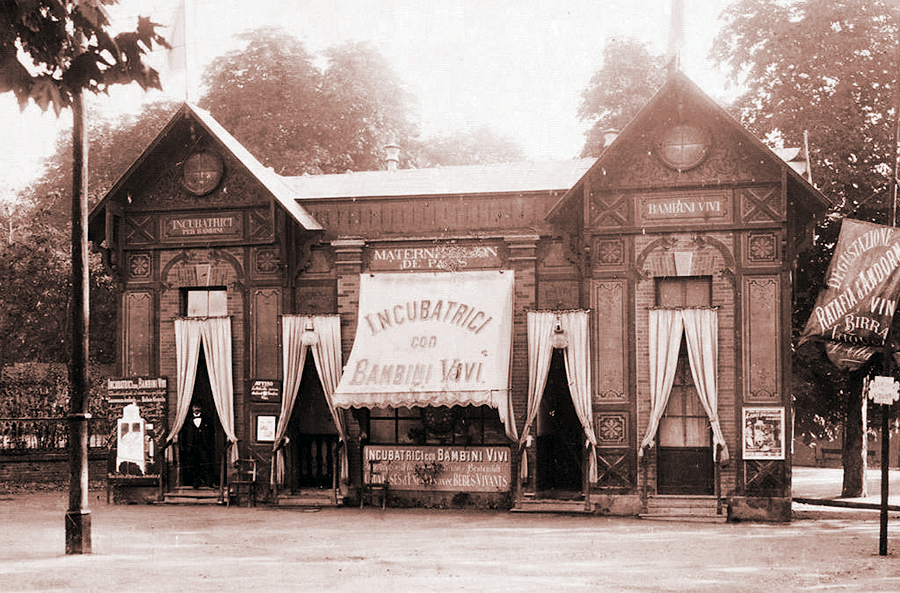
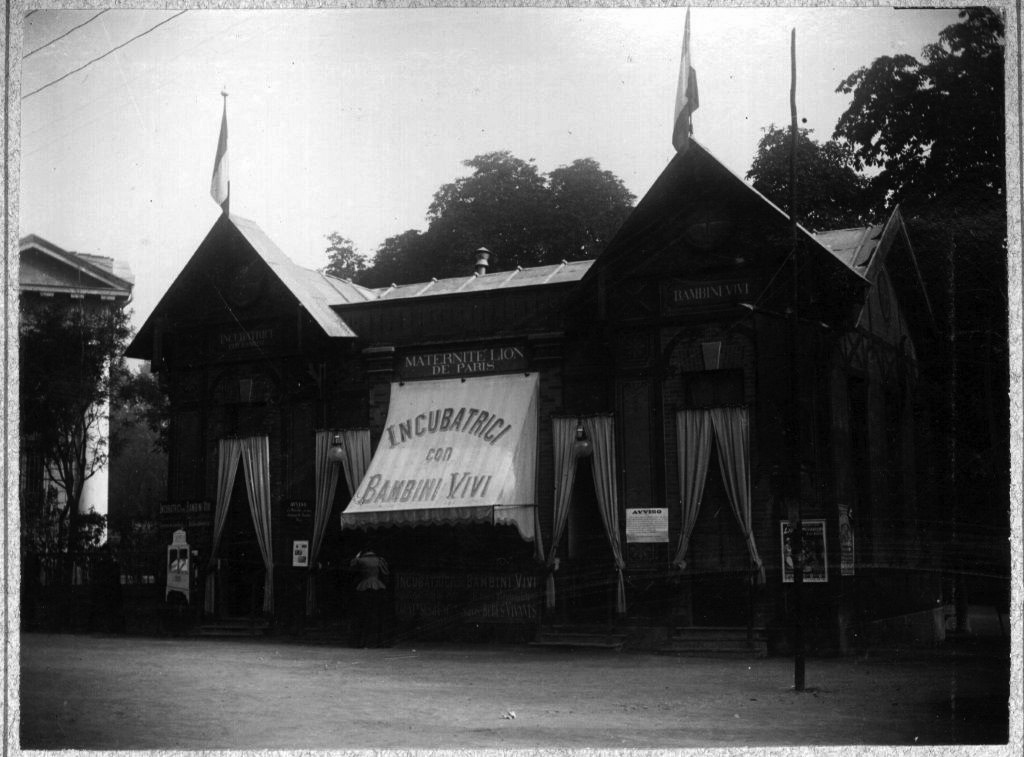
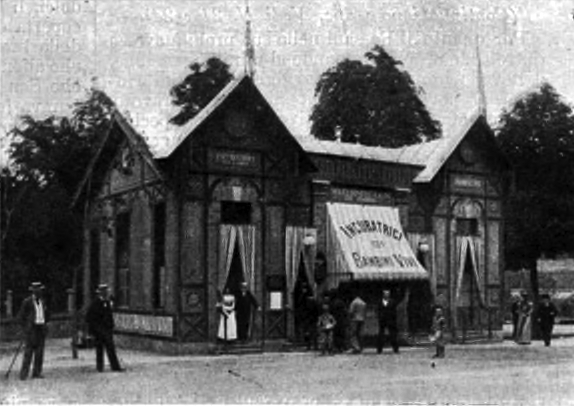
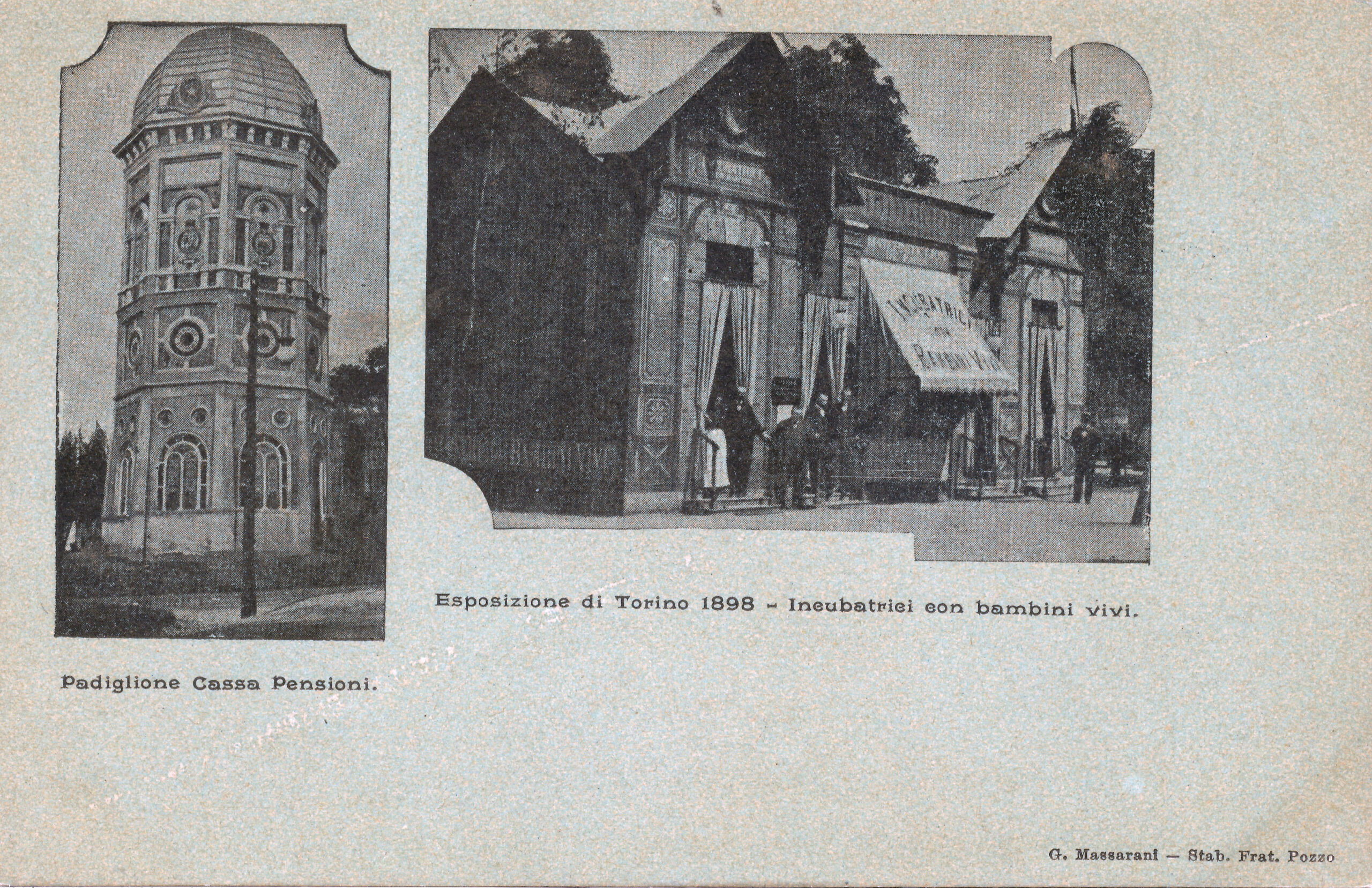
There is also a souvenir postcard that includes a photo of the incubator pavilion, although it is rare on auction sites. None of Lion’s typical souvenir postcards using his usual templates and stock photos have been discovered to date.
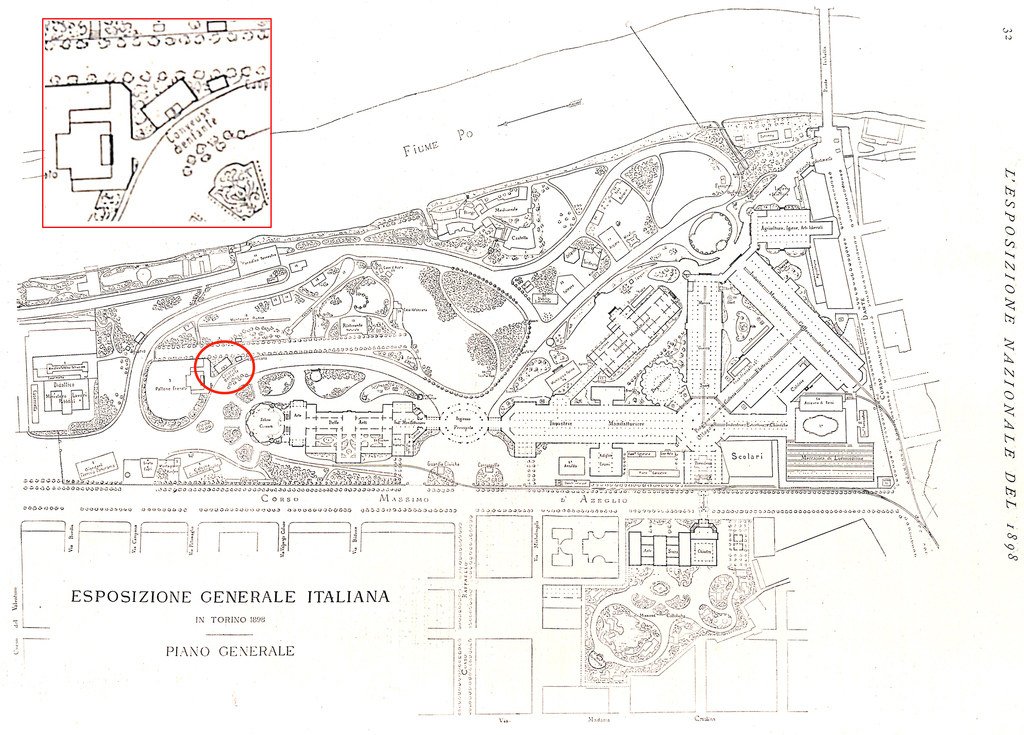
A map of the exhibit grounds is shown below. The location of the couveuse pavilion is marked.
Sources
- “Esposizione generale italiana del 1898.” Wikipedia (Italian). https://it.wikipedia.org/wiki/Esposizione_generale_italiana_del_1898
- “Le esposizioni.” Atlante di Torino. https://www.atlanteditorino.it/monografie/esposizioni.html
- 1898: L’Esposizione Nazionale. Turin: Roux Frassati e C., 1898. Originally issued in 39 parts. https://archive.org/details/gri_33125008531234
- L’Esposizione Nazionale del 1898, No. 22, p. 175, incubator babies “stretching out their tiny feet and arms.”
- Guida Ufficiale della Esposizione Nazionale e della Mostra di Arte Sacra. Turin: Roux Frassati & C., 1898.
- Della Coletta, Cristina. World’s Fairs Italian Style: The Great Exhibitions in Turin and Their Narratives, 1860–1915. Toronto: University of Toronto Press, 2006.
- Stella, Federica, and Annalisa Dameri. “Torino 1898–Parigi 1900: Carlo Ceppi, Costantino Gilodi e Giacomo Salvadori tra tradizione e innovazione.” MDCCC 1800 6 (2017): 97–106. doi:10.14277/2280-8841/MDCCC-6-17-7
- “Secondo Pia.” Wikipedia. https://en.wikipedia.org/wiki/Secondo_Pia
- Damon, P. E., et al. “Radiocarbon Dating of the Shroud of Turin.” Nature 337 (1989): 611–615. https://www.nature.com/articles/337611a0
- “L’inaugurazione dell’Esposizione Nazionale e della Mostra d’Arte Sacra.” La Stampa (Turin), 2 May 1898, p. 1.
- “Le incubatrici per bambini.” La Stampa (Turin), 20 May 1898, p. 3.
- “L’Esposizione di Torino — La giornata d’oggi,” La Stampa, June 12, 1898, p. 2.
- Minneci di Villareal, E. “Le incubatrici per bambini (couveuses d’enfants) all’Esposizione Nazionale di Torino.” L’Illustrazione Italiana 25, no. 25 (19 June 1898): 428.
- “« Les couveuses d’enfants ».” La Stampa (Turin), 19 July 1898, p. 3.
- “Le incubatrici per bambini,” La Stampa, October 31, 1898, p. 2.
- “L’Esposizione Generale: L’ultima giornata dell’Esposizione.” La Stampa (Turin), 21 November 1898, p. 2. Gives the closing date as November 20, final visitor count.
- “L’Exposition Générale Italienne de Turin,” Cosmos, October 8, 1898, pp. 459-464.
* Wikipedia and Atlante di Torino give the attendance as “three and a half million.” The larger number may count the Sacred Art exhibition, repeat season-ticket entries, or both, but the evidence is unclear.
More Information about Alexandre Lion
- General Information
- Alexandre Lion
- The Lion Incubator
- The Engineer and the Newborns, by W. A. Nelson and Paul L. Toubas
- Lion Patents (France)
- Patent 201550, 1889, Couveuse électro-automatique
- Patent 221716, 1892, Couveuse automatique
- Patent 262090, 1896, Chambre vivifiante
- Patent 281687, 1898, Système de filtration de l’air
- Patent 287557, 1899, Système de filtration des fumées, de l’air et de toutes masses gazeuses avec tirage et ventilation
- Patent 189989, 1899, Appareil pour le filtrage et la purification de l’air et des fumées
- Maternité Lion Institutes and City Exhibits
- Alexandre Lion’s first incubator baby exhibit in Marseille, 1890.
- Œuvre Maternelle des Couveuses d’Enfants, Nice
- Œuvre Maternelle des Couveuses d’Enfants, Lyon
- Œuvre Maternelle des Couveuses d’Enfants, Paris
- Œuvre Maternelle des Couveuses d’Enfants, Toulouse
- Œuvre Maternelle des Couveuses d’Enfants, Amiens
- Œuvre Maternelle des Couveuses d’Enfants, New York
- Œuvre Maternelle des Couveuses d’Enfants, Barcelona
- Œevre Maternelle des Couveuses d’Enfants, Brussels
- Maternité Lion Souvenir Booklets
- Œuvre Maternelle des Couveuses d’Enfants , Paris Institute, Booklet Version #1 (appears to be ~1896)
- Œuvre Maternelle des Couveuses d’Enfants , Paris Institute, Booklet Version #2 (appears to be ~1901)
- Pamphlet from Alexander Lion’s exhibit at the 1898 exhibition in Torino, Italy. (PDF supplied by Dr. Thijs Gras, Amsterdam)
- Press Coverage
- La Maternité “Lion de Nice” pour Enfants Nés Avant Terme ou Débiles, by Dr. Ciaudo, 1895. Source: gallica.bnf.fr.

- Presentation d’Appareil, by M. A. Pinard, Bulletin de l’Académie nationale de médecine, 1893. Source: gallica.bnf.fr.
- Les couveuses d’enfant et le gavage, by César-A Queirolo, Includes discussion of Lion incubator and comparison to other types. Thèse de doctorat: Univ. Genève, 1897.
- Les Couveuses pour Enfants, Gazette Médicale de Paris, No. 40, October 6, 1900
- Couveuses d’Enfants, La Maternité Lion, Paris, La Patrie, 1897
- Paris Letter: An Improved System of Incubators, by O. Jennings, Pediatrics 1:427-428, 1896
- Baby Incubators, The Strand Magazine, 1896, by James Walter Smith
- Human Infant Incubation: A True Fairy-Tale of Modern Science from Leslie’s Weekly, 1897
- The Saving of Human Life, Maternité Lion in NYC, The Literary Digest, 1898
- Immature Infants in France, from The Lancet, January 16, 1897, page 196.
- De Lion Incubator at Low Maternity Hospital, by Francis H. Stuart, Brooklyn Medical Journal, 1901
- Alexandre Lion’s Incubator Charities in Europe (1894–1898) (The Embryo Project)
- La Maternité “Lion de Nice” pour Enfants Nés Avant Terme ou Débiles, by Dr. Ciaudo, 1895. Source: gallica.bnf.fr.
- Worlds Fairs and Expositions
- Maternité Lion at the Lyon Exposition Universelle et Coloniale, 1894
- Maternité Lion at the Lyon Exposition Universelle – Le Monde Illustré, 1894
- Maternité Lion at the Bordeaux Exposition of 1895.
- “La Maternité Lion,” by Louis Énault, Journal of the Bordeaux Exposition, 1895
- Maternité Lion at the Amsterdam World Exposition, 1895
- Maternité Lion at the Berliner Gewerbeausstellung, 1896
- “Bericht ǔber die Couveuse (Lion) oder Kinderbrutanstalt” [Report about the Lion Incubator] from Berlin und seine Arbeit – Amtlicher Bericht der Berliner Gewerbe-Ausstellung 1896. English Translation.
- Maternité Lion at the Exposition National Suisse, Geneva, Switzerland, 1896
- “Quelques Réflexions sur le Fonctionnement et les Résultats des Couveuses Lion pendant l’Exposition Nationale,” by Dr. Hector Maillart, Revue Médicale de La Suisse Romande, 1896. English translation.
- Internationale Ausstellung für Körperliche Erziehung, Gesundheitspflege und Sport, Innsbruck, 1896
- Maternité Lion at the Tennessee Centennial Exposition, 1897
- Maternité Lion at the Brussels International Exposition, 1897
- Maternité Lion at the Turin L’Esposizione Generale Italiana, 1898
- Maternite Lion at the Ghent Provincial Exposition of 1899
- Maternité Lion at the Greater Britain Exhibition of 1899
- Maternité Lion at the Paris Exposition Universelle of 1900
- Maternité Lion at the Woman’s Exhibition in Earls Court, London, 1900
- Maternité Lion at the Lille Exposition of 1902
- Maternité Lion at the Exposition Internationale de Reims, 1903
- Maternité Lion at the Nantes Exposition of 1904
- Maternité Lion at the Exposition du Nord de la France, 1904
- Maternité Lion at the Liège Exposition Universelle et Internationale, 1905.
- Maternité Lion at the Marseille Colonial Exposition of 1906
- Maternite Lion at the Bordeaux International Maritime Exposition of 1907
- Maternité Lion at the Marseille Exposition Internationale d’Électricité, 1908
- Maternité Lion at the Exposition Internationale de l’Est de la France, Nancy, France, 1909
- Maternité Lion at the Brussels Exposition Universelle et Internationale, 1910
- Maternite Lion at the Exposition du Centre de la France, Clermont-Ferrand, 1910
- Maternité Liion at the Rome International Exposition of 1911
- Maternité Lion at the Turin International Exposition of 1911
- Maternité Lion at the Exposition Internationale de Dunkerque, 1912
- Maternité Lion at the Ghent International Exposition of 1913
- Maternité Lion at the Exposition Internationale Urbaine de Lyon, 1914
- Maternité Lion at the Lyon Exposition Universelle et Coloniale, 1894
French and Italian primary sources were machine-translated, then edited and verified manually by the author.
Portions of this page were drafted with machine assistance; the final text was reviewed, verified, and edited by the author. Click here to learn more.
Last Updated on 10/04/26